Question
  1. Show that the normal component of electrostatic field has a discontinuity from one side of a charged surface to another given by
$(\text{E}_2-\text{E}_1).\hat{\text{n}}=\frac{\sigma}{\epsilon_0}$
where $\hat{\text{n}}$ is a unit vector normal to the surface at a point and $\sigma$ is the surface charge density at that point. $ ($The direction of $\hat{\text{n}}$ is from side $1$ to side $2.)$ Hence show that just outside a conductor, the electric field is $\sigma \hat{\text{n}} /ε_0.$
  1. Show that the tangential component of electrostatic field is continuous from one side of a charged surface to another.
$[$Hint: For $(a),$ use Gauss’s law. For $, (b)$ use the fact that work done by electrostatic field on a closed loop is zero.$]$

Answer

  1. Electric fielcl on one side of a charged body is $E_1$ and electric field on the other side of the same body is $E_2$. If infinite plane charged body has a uniform thickness, then electric field due to one surface of the charged body is given by,
  1. $\vec{\text{E}}_1=-\frac{\sigma}{2\in_0}\hat{\text{n}} \dots\dots(1)$
    Where,
    $\hat{\text{n}} =$ Unit vector normal to the surface at a point
    $\sigma = $ Surface charge density at that point
    Electric field due to the other surface of the charged body,
    $\vec{\text{E}}_2=-\frac{\sigma}{2\in_0}\hat{\text{n}} \dots\dots(2)$
    Electric field at any point due to the two surfaces,
    $\vec{\text{E}}_2-\vec{\text{E}}_1=\frac{\sigma}{2\in_0}\hat{\text{n}}+\frac{\sigma}{2\in_0}\hat{\text{n}}=\frac{\sigma}{\in_0}\hat{\text{n}}$
    $(\vec{\text{E}}_2-\vec{\text{E}}_1).\hat{\text{n}}=\frac{\sigma}{\in_0} \dots\dots(3)$
    Since inside a closed conductor, $\vec{\text{E}}_1=0,$
    $\therefore\vec{\text{E}}=\vec{\text{E}}_2=-\frac{\sigma}{2\in_0}\hat{\text{n}}$
    Therefore, the electric fielcl just outside the conductor is $\frac{\sigma}{\in_0}\hat{\text{n}}.$
  2. When a charged particle is moved from one point to the other on a closed loop, the work done by the electrostatic field is zero.
  3. Hence, the tangential component of electrostatic field Is continuous from one side of a charged surface to the other.

Need a full question paper?

Generate a complete, print-ready paper with questions like this in minutes — across 16+ boards, with answer keys.

Start Generating Free

Similar questions

Draw a ray diagram of image formation by a concave mirror and establish the relation between object distance $(u)$, image distance ($v$) and focal length $(f)$.
Find the speed at which the kinetic enei:gy of a particle will differ by 1% from its nonrelativistic value $\frac{1}{2}\text{m}_0\text{v}^2$
If the nucleons of a nucleus are separated from each other, the total mass is increased. Where does this mass come from?
A long solenoid with 15 turns per cm has a small loop of area 2.0 cm² placed inside the solenoid normal to its axis. If the current carried by the solenoid changes steadily from 2.0 A to 4.0 A in 0.1 s. What is the induced emf in the loop while the current is changing?
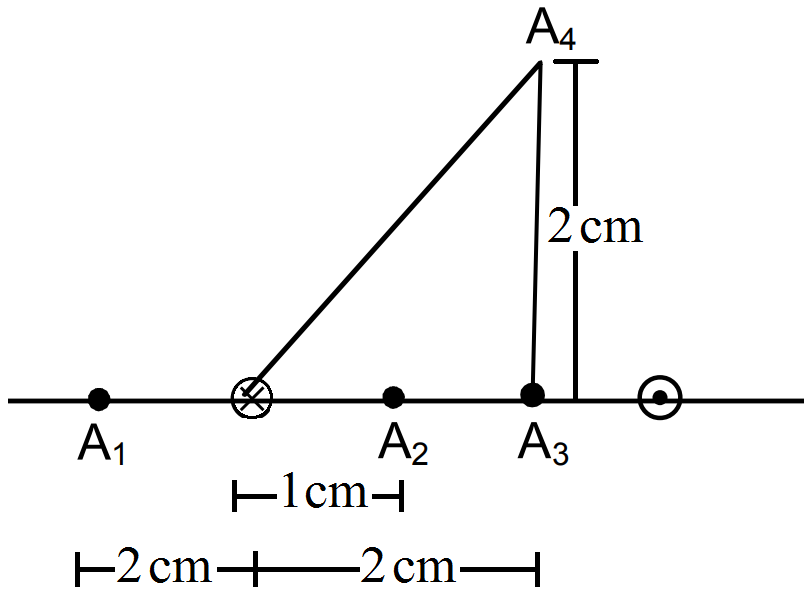
Figure shows two parallel wires separated by a distance of $4.0\ cm$ and carrying equal currents of $10A$ along opposite directions. Find the magnitude of the magnetic field $B$ at the points $A_1, A_2, A_3$ and $A_4$.
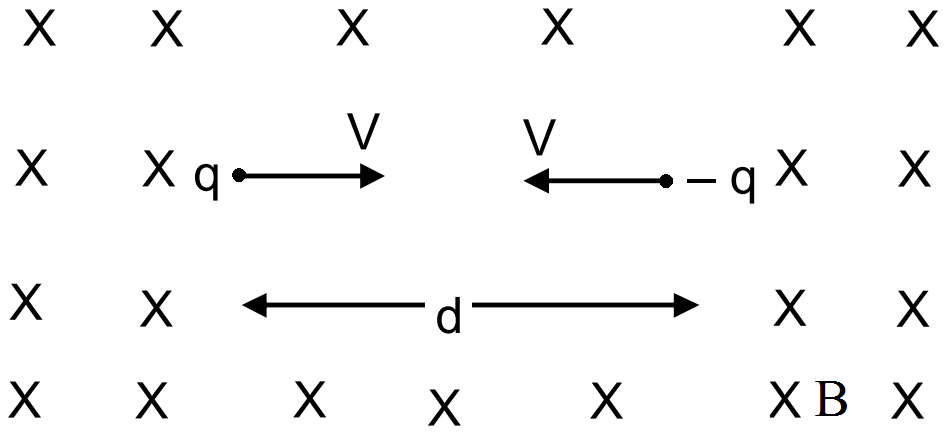
Two particles, each with mass $m$ are placed at a separation $d$ in a uniform magnetic field $B$, as shown in the figure. They have opposite charges of equal magnitude $q.$ At time $t = 0,$ the particles are projected towards each other, each with a speed $v.$ Suppose the Coulomb force between the charges is switched off.
  1. Find the maximum value $v_m$ of the projection speed, so that the two particles do not collide.
  2. What would be the minimum and maximum separation between the particles if $\text{v}=\text{v}_{\text{m}}\sqrt{2}?$
  3. At what instant will a collision occur between the particles if $v = 2v_m$?
  4. Suppose $v = 2v_m$ and the collision between the particles is completely inelastic. Describe the motion after the collision.
A table with smooth horizontal surface is fixed in a cabin that rotates with a uniform angular velocity $\omega$ in a circular path of radius R (In figure). A smooth groove AB of length L(<$\theta$ with the radius OA of the circle in which the cabin rotates. A small particle is kept at the point A in the groove and is released to move along AB. Find the time taken by the particle to reach the point B.
An adiabatic vessel of total volume $V$ is divided into two equal parts by a conducting separator. The separator is fixed in this position. The part on the left contains one mole of an ideal gas $(U = 1.5\ nRT)$ and the part on the right contains two moles of the same gas. Initially, the pressure on each side is $p$. The system is left for sufficient time so that a steady state is reached. Find,
  1. The work done by the gas in the left part during the process.
  2. The temperature on the two sides in the beginning.
  3. The final common temperature reached by the gases.
  4. The heat given to the gas in the right part.
  5. The increase in the internal energy of the gas in the left part.
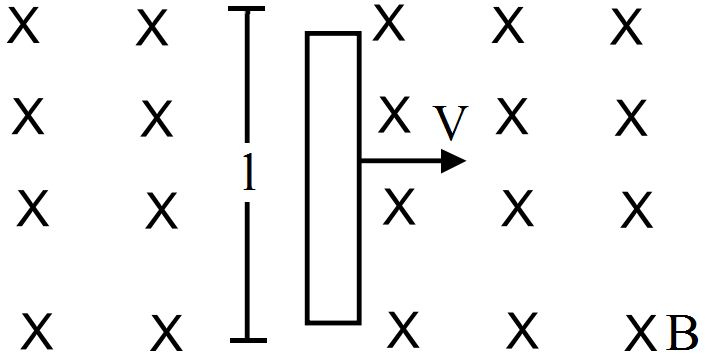
A conducting wire of length l, lying normal to a magnetic field B, moves with a velocity v, as shown in the figure.
  1. Find the average magnetic force on a free electron of the wire.
  2. Due to this magnetic force, electrons concentrate at one end, resulting in an electric field inside the wire. The redistribution stops when the electric force on the free electrons balances the magnetic force. Find the electric field developed inside the wire when the redistribution stops.
  3. What potential difference is developed between the ends of the wire?
A neutron moving with a speed $υ$ strikes a hydrogen atom in ground state moving towards it with the same speed. Find the minimum speed of the neutron for which inelastic $($completely or partially$)$ collision may take place. The mass of neutron $=$ mass of hydrogen $= 1.67 \times 10^{-27}kg$.