Question
Show that the point $(0, 9)$ is equidistant from the points $(– 4, 1)$ and $(4, 1)$

Answer

Let $P\left(x_1, y_1\right)=P(0,9), Q\left(x_2, y_2\right)=Q(-4,1), R\left(x_3, y_3\right)=R(4,1)$
By distance formula,
$ d(P, Q)=\sqrt{\left(x_2-x_1\right)^2+\left(y_2-y_1\right)^2}$
$=\sqrt{[(-4)-0]^2+(1-9)^2}$
$=\sqrt{(-4)^2+(-8)^2}$
$=\sqrt{16+64}$
$=\sqrt{80}$
$=4 \sqrt{5} $
And
$ d(P, R)=\sqrt{\left(x_3-x_1\right)^2+\left(y_3-y_1\right)^2}$
$=\sqrt{(4-0)^2+(1-9)^2}$
$=\sqrt{4^2+(-8)^2}$
$=\sqrt{16+64}$
$=\sqrt{80}$
$=4 \sqrt{5} $
And
$d(P, R)=\sqrt{\left(x_3-x_1\right)^2+\left(y_3-y_1\right)^2}$
$=\sqrt{(4-0)^2+(1-9)^2}$
$=\sqrt{4^2+(-8)^2}$
$=\sqrt{16+64}$
$=\sqrt{80}$
$=4 \sqrt{5}$
Here, $d(P, Q)=d(P, R)$
$\therefore$ The point $(0,9)$ is equidistant from $(-4,1)$ and $(4,1)$.

Need a full question paper?

Generate a complete, print-ready paper with questions like this in minutes — across 16+ boards, with answer keys.
Start Generating Free

Similar questions

Solve the following simultaneous equations.
$\frac{7}{2 x +1}+\frac{13}{ y +2}=27 ; \frac{13}{2 x +1}+\frac{7}{ y +2}=33$
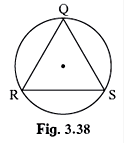
In fig 3.38 ∆ QRS is an equilateral triangle. Prove that,
(1) arc RS ≅ arc QS ≅ arc QR
(2) m(arc QRS) = 240°.
There are three consecutive integers such that the square of the first increased by the product of the other two gives $154$. What are the integers.
The difference of squares of two number is $88$. If the larger number is $5$ less than twice the smaller number, then find the two numbers.
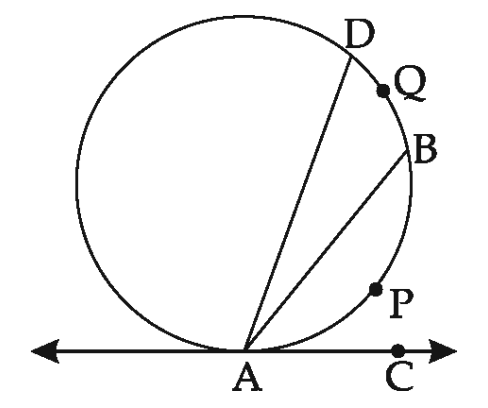
Seg AB and seg AD are the chords of the circle. C is a point on tangent of the circle at point A. If m(arc APB) 80° = and $\angle$BAD = 30°. Then find (i) $\angle$BAC (ii) m(arc BQD).
Image
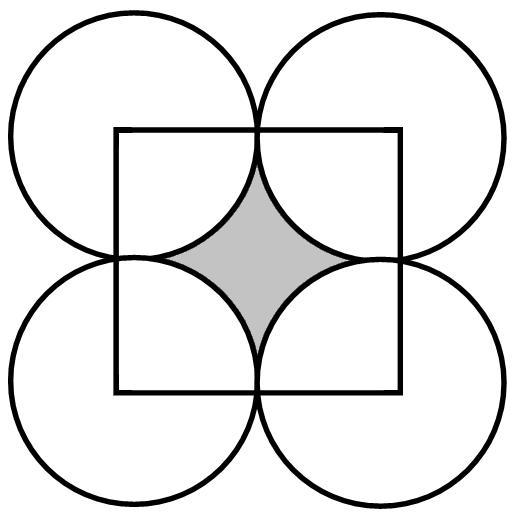
The diameter of a coin is $1\ cm$ (in the following figure). If four such coins be placed on a table so that the rim of each touches that of the other two, find the area of the shaded region $\big(\text{Take }\pi = 3.1416\big). $
A copper sphere of diameter 18cm is drawn into a wire of diameter 4mm. Find the length of the wire.
Taking $\theta=30^{\circ}$ to verify the following Trigonometric identities :
(i) $\sin^{2}\theta+\cos^{2}\theta=1$
(ii) $1+\tan^{2}\theta=\sec^{2}\theta$
(iii) $1+\cot^{2}\theta=\csc^{2}\theta$.
A spherical cannon ball 28cm in diameter is melted and recast into a right circular conical mould, base of which is 35cm in diameter. Find the height of the cone.
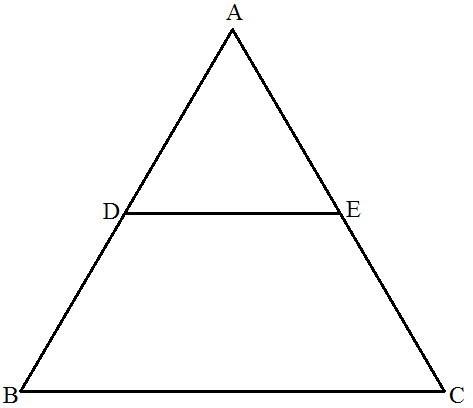
In the given figure, DE || BC
If DE = 4cm, BC = 8cm and Area $(\triangle\text{ADE})=25\text{cm}^2$, find the area of $\triangle\text{ABC}.$