Question
Show that the points whose position vectors are $-2\hat{\text{i}}+3\hat{\text{j}},\hat{\text{i}}+2\hat{\text{j}}+3\hat{\text{k}}$ and $7\hat{\text{i}}-\hat{\text{k}}$ are collinear.

Answer

Let the given points be P, Q and R and let their position vectors be $\vec{\text{a}},\vec{\text{b}}$ and $\vec{\text{c}},$ respectively.
$\vec{\text{a}}=-2\hat{\text{i}}+3\hat{\text{j}}$
$\vec{\text{b}}=\hat{\text{i}}+2\hat{\text{j}}+3\hat{\text{k}}$
$\vec{\text{c}}=7\hat{\text{i}}+9\hat{\text{k}}$
Vector equation of line passing through P and Q is
$\vec{\text{r}}=\vec{\text{a}}+\lambda\big(\vec{\text{b}}-\vec{\text{a}}\big)$
$\Rightarrow\vec{\text{r}}=\big(-2\hat{\text{i}}+3\hat{\text{j}}\big)+\lambda\big\{\big(\hat{\text{i}}+2\hat{\text{j}}+3\hat{\text{k}}\big)-\big(-2\hat{\text{i}}+3\hat{\text{j}}\big)\big\}$
$\Rightarrow\vec{\text{r}}=\big(-2\hat{\text{i}}+3\hat{\text{j}}\big)+\lambda\big(3\hat{\text{i}}-\hat{\text{j}}+3\hat{\text{k}}\big)\dots(1)$
If points P, Qand R are collinear, then point R must satisfy (1).
Replacing $\vec{\text{r}}$ by $\vec{\text{c}}=7\hat{\text{i}}+9\hat{\text{k}}$ in (1), we get
$7\hat{\text{i}}+9\hat{\text{k}}=\big(-2\hat{\text{i}}+3\hat{\text{j}}\big)+\lambda\big(3\hat{\text{i}}-\hat{\text{j}}+3\hat{\text{k}}\big)$
Comparing the coefficients of $\hat{\text{i}},\hat{\text{j}}$ and $\hat{\text{k}},$ we get
$7=-2+3\lambda,0=3-\lambda,9=3\lambda$
$\therefore\lambda=3$
These three equations are consistent, i.e. they give the same value of $\lambda.$
Hence, the given three points are colinear.
Disclaimar: The question given in the book has a minor error. The third vectors should be $7\hat{\text{i}}+9\hat{\text{k}}.$
The solution here is created accordingly

Need a full question paper?

Generate a complete, print-ready paper with questions like this in minutes — across 16+ boards, with answer keys.
Start Generating Free

Similar questions

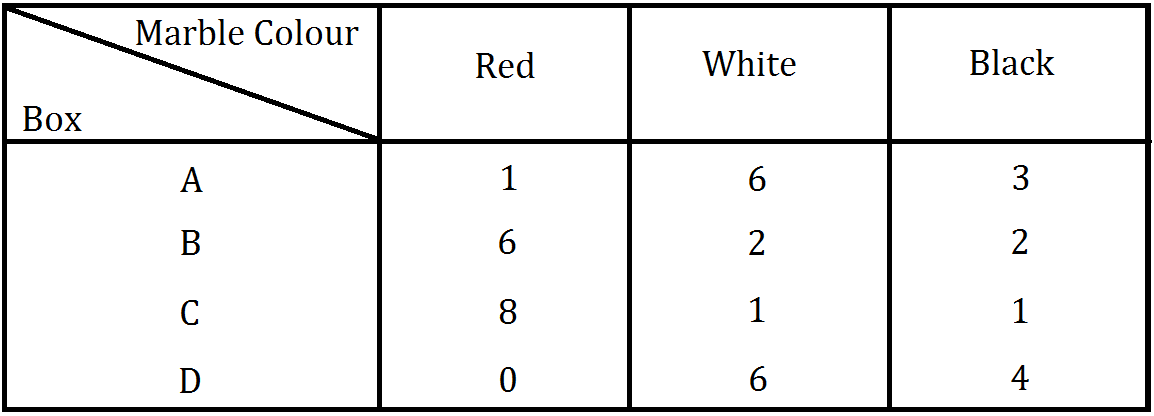
Suppose we have four boxes A, B, C, D containing coloured marbles as given below:
One of the boxes has been selected at random and a single marble is drawn from it. If the marble is red, what is the probability that it was drawn from,
  1. Box A?
  2. Box B?
  3. Box C?
Without expanding, show that the values of the following determinant are zero:
$\begin{vmatrix}1&\text{a}&\text{a}^2-\text{bc}\\1&\text{b}&\text{b}^2-\text{ac}\\1&\text{c}&\text{c}^2-\text{ab} \end{vmatrix}$
Find the area of the ragion bounded by $x^2+ 16y = 0$ and its latusrectum.
Evaluate the following integrals:
$\int\limits^{\frac{\pi}{2}}_0\sin2\text{x }\tan^{-1}(\sin\text{x})\text{dx}$
Two dice are thrown together and the total score is noted. The event E, F and G are "a total of 4", "a total of 9 or more", and "a total divisible by 5", respectively. Calculate P(E), P(F) and P(G) and decide which pairs of events, if any, are independent.
Solve the following differential equation:
$2\text{xy dx}+(\text{x}^2+2\text{y}^2)\text{dy}=0$
Integrate the rational function in exercise:
$\frac{1}{(\text{e}^\text{x}-1)}$
$[$Hint: Put $e^x = t]$
Find the point on the curvey $y^2= 2x$ which is at a minimum distance from the point $(1, 4).$
A factory manufactures two types of screws, A and B, each type requiring the use of two machines - an automatic and a hand-operated. It takes 4 minute on the automatic and 6 minutes on the hand-operated machines to manufacture a package of screws 'A', while it takes 6 minutes on the automatic and 3 minutes on the hand-operated machine to manufacture a package of screws 'B'. Each machine is available for at most 4 hours on any day. The manufacturer can sell a package of screws 'A' at a profit of 70 P and screws 'B' at a profit of Rs. 1. Assuming that he can sell all the screws he can manufacture, how many packages of each type should the factory owner produce in a day in order to maximize his profit? Determine the maximum profit.
A rubber company is engaged in producing three types of tyres A, B and C. Each type requires processing in two plants, Plant I and Plant II. The capacities of the two plants, in number of tyres per day, are as follows:
Plant
A
B
C
I
50
100
100
II
60
60
200
The monthly demand for tyre A, B and C is 2500, 3000 and 7000 respectively. If plant I costs Rs. 2500 per day, and plant II costs Rs. 3500 per day to operate, how many days should each be run per month to minimize cost while meeting the demand? Formulate the problem as LPP.