Question
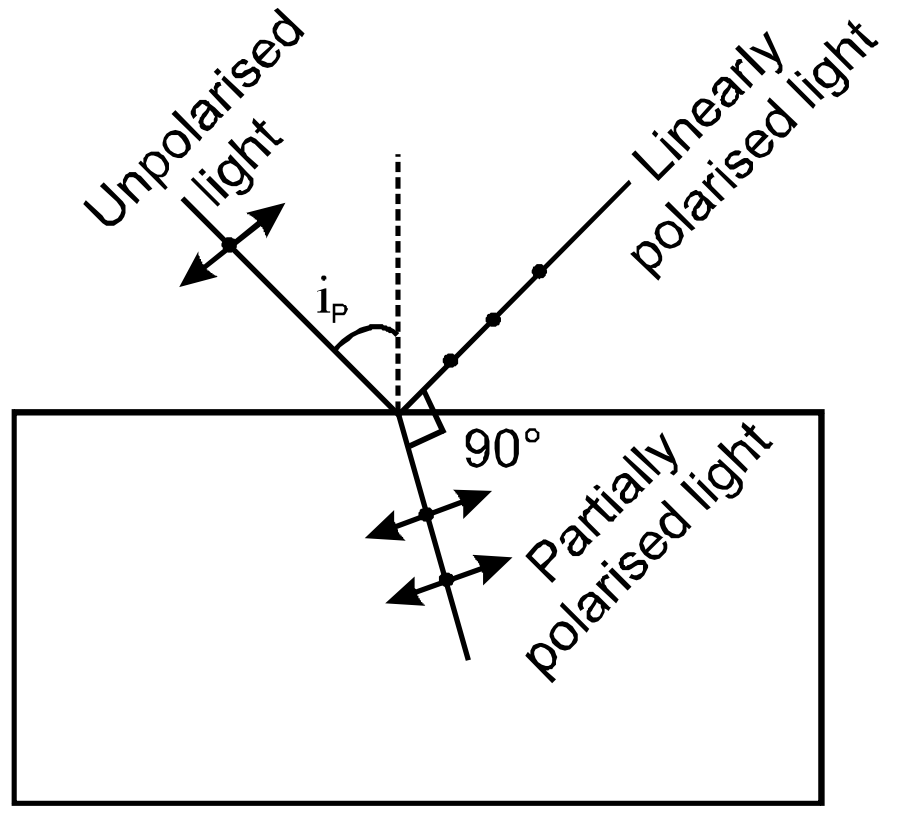
  1. Show using a proper diagram how unpolarised light can be linearly polarised by reflection from a transparent glass surface.
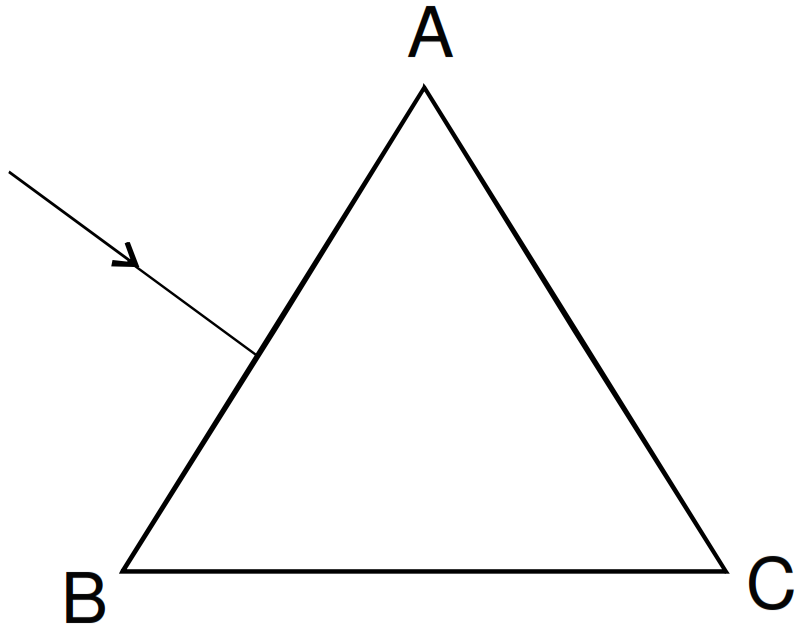
  2. The figure shows a ray of light falling normally on the face AB of an equilateral glass prism having refractive index $\frac{3}{2},$ placed in water of refractive index $\frac{4}{3}.$ Will this ray suffer total internal reflection on striking the face AC? Justify your answer.
Answer

  1.  

When unpolarised light ray is incident at an angle such that the angle between reflected of refracted rays is 90°, then reflected ray is linearly polarised. In that case incident angle is called polarising angle or Brewster angle(iP or iB).

  1. For Total internal reflection $\Big(\frac{1}{\sin\text{i}_{\text{c}}}=\mu_{\text{DR}}\Big)$

$\sin\text{i}_{\text{c}}=\Big(\frac{1}{\sin\text{i}_{\text{c}}}=\mu_{\text{DR}}\Big)$

$\sin\text{i}_{\text{c}}=\mu_{\text{wg}}$

$\sin\text{i}_{\text{c}}=\frac{4}{3}\div\frac{3}{2}$

$=\frac{4}{3}\times\frac{2}{3}$

$\sin\text{i}_{\text{c}}=\frac{8}{9}=0.88$

Now, in this case

$\sin\text{i}=\sin60^\circ=\frac{\sqrt{3}}{2}=0.867$

$\because\ \sin\text{i}<\sin\text{i}_{\text{c}}$

$\text{So,}\ \text{i}<\text{i}_{\text{c}}$

So, ray will not suffer Total internal reflection.

Need a full question paper?

Generate a complete, print-ready paper with questions like this in minutes — across 16+ boards, with answer keys.

Start Generating Free

Similar questions

A ball is dropped from a balloon going up at a speed of 7m/s. If the balloon was at a height 60m at the time of dropping the ball, how long will the ball take in reaching the ground?
In a photoelectric experiment, the collector plate is at 2.0V with respect to the emitter plate made of copper ($\phi$ - 4.5eV). The emitter is illuminated by a source of monochromatic light of wavelength 200 run. Find the minimum and maximum kinetic energy of the photoelectrons reaching the collector.
In Young’s double slit experiment, the two slits are separated by a distance of 1·5 mm and the screen is placed 1 m away from the plane of the slits. A beam of light consisting of two wavelengths 650 nm and 520 nm is used to obtain interference fringes. Find.
  1. The distance of the third bright fringe for$\lambda = 520$ nm on the screen from the central maximum.
  2. The least distance from the central maximum where the bright fringes due to both the wavelengths coincide.
Explain with the help of a diagram, how a depletion layer and barrier potential are formed in a junction diode.
Suppose a monochromatic X-ray beam of wavelength 100pm is sent through a Young's double slit and the interference pattern is observed on a photographic plate placed 40cm away from the slit. What should be the separation between the slits so that the successive maxima on the screen are separated by a distance of 0.1mm?
Write the product of equivalent capacitances when 10 capacitors, each having a capacitance of $10 \mu F$, are connected in series and then parallel connection.
An ideal gas expands from 100cm3 to 200cm3 at a constant pressure of 2.0 × 10⁵ Pa when 50J of heat is supplied to it. Calculate,
  1. The change in internal energy of the gas.
  2. The number of moles in the gas if the initial temperature is 300K.
  3. The molar heat capacity Cp at constant pressure.
  4. The molar heat capacity Cv at constant volume.
Consider a 10cm long piece of a wire which carries a current of 10A. Find the magnitude of the magnetic field due to the piece at a point which makes an equilateral triangle with the ends of the piece.
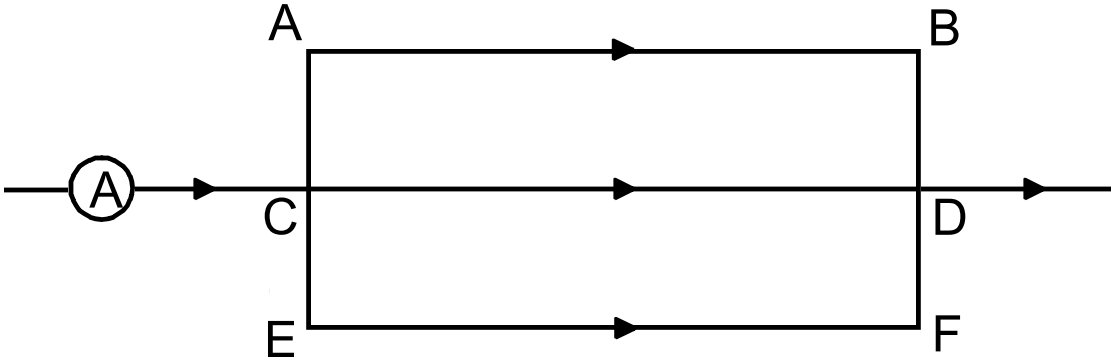
Figure shows a part of an electric circuit. The wires AB, CD and EF are long and have identical resistances. The separation between the neighbouring wires is 1.0cm. The wires AE and BF have negligible resistance and the ammeter reads 30A. Calculate the magnetic force per unit length of AB and CD.

If both the number of protons and number of neutrons are conserved in each nuclear reaction, in what way is mass converted into energy (or vice-versa) in a nuclear reaction?