Question

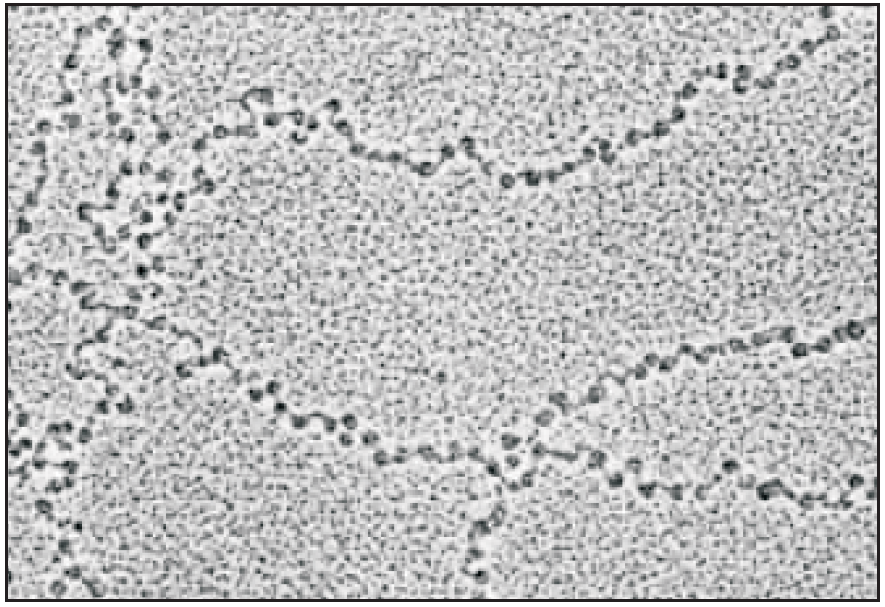
Shown above is the electron micrograph (EM) picture of 'beads-on-string'.
  1. Identify and explain the detailed structure of a bead with the help of a labelled diagram.
  2. Describe the packaging of 'beads-on-string'in a eukaryotic cell.

Answer

  1. The bead-like structures are the nucleosomes:
  1. There is a set of positively charged proteins, called histones, rich in basic amino acid residues, lysine and arginine.
  2. Histones are organised to form a unit of eight molecules, called histone octamer.
  3. The negatively charged DNA is wrapped around the positively charged histone octamer, to form a nucleosome; a nucleosome contains 200 bp of DNA helix.
  1.  
  1. The nucleosomes form the repeating units of the chromatin fibre in the nucleus; these nucleosomes of a chromatin are seen as the beads-on-string structure under electron microscope.
  2. The chromatin fibres are further coiled and condensed at metaphase stage to form the chromosomes.
  3. The packaging of chromatin at higher levels requires another set of proteins, called non histone chromosomal (NHC) proteins.

Need a full question paper?

Generate a complete, print-ready paper with questions like this in minutes — across 16+ boards, with answer keys.

Start Generating Free

Similar questions

  1. In humans, males are heterogametic and females are homogametic. Explain. Are there any examples where males are homogametic and females heterogametic?
  2. Also describe as to, who determines the sex of an unborn child? Mention whether temperature has a role in sex determination.
What do you understand by pond ecosystem?###Describe structure and function of an ecosystem.
a. Draw a diagram of a fully developed embryo sac of an angiosperm. Label its chalazal end and any other five parts within the embryo sac.
b. Why does the development of an endosperm precede that of the embryo in angiosperm?
c. Number of chromosomes in an onion plant cell is 16. Name the cells of the embryo sac having 16 and 24 chromosomes formed after fertilisation.
How does a chromosomal disorder differ from a Mendelian disorder?
Explain briefly the ‘rivet popper hypothesis’ of Paul Ehrlich.
  1. Explain the phenomenon of multiple allelism and co-dominance taking ABO blood group as an example,
  2. What is the phenotype of the following:
  1. IAi
  2. ii
Draw a diagrammatic sketch of the sectional view of a typical anatropous ovule.

OR

Draw a labelled diagram of the sectional view of a typical anatropous ovule.

A group of students visited a botanical garden, where they saw fungus growing on roots of higher plants only. They were confused seeing it. Then, their teacher told them that it is an interspecific interaction in which both species can be benefitted.
  1. Write the name of this particular association.
  2. How both are benefitted from each other?
  3. State use of this interaction to a farmer.
  4. What values are shown by students?
F1–generation does not resemble either of the parents.
i. Double fertilisation is an event unique to all flowering plants. Explain the process.
ii. Give a reason for the following:
a. A seed of an orange has many embryos.
b. Cashew is a false fruit but Guava is a true fruit.