Question

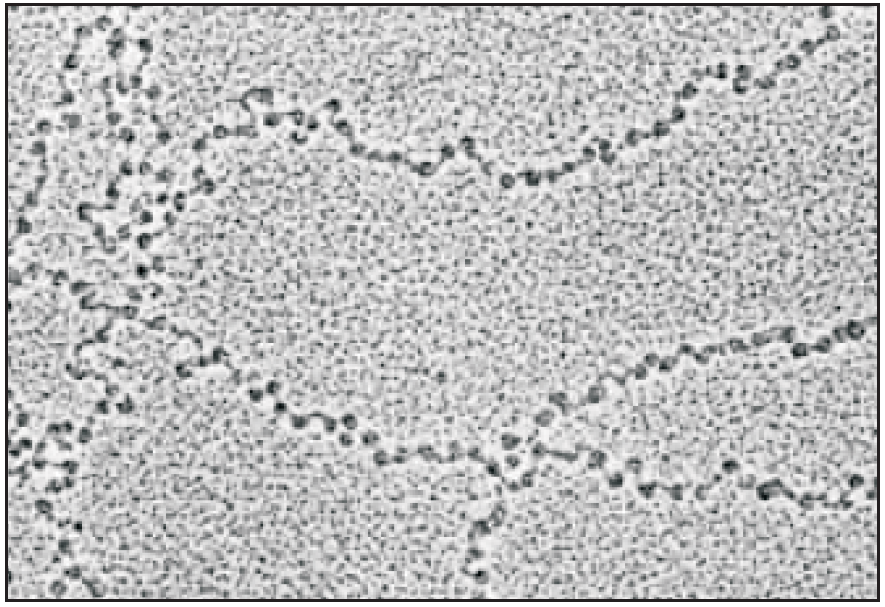
Shown above is the electron micrograph (EM) picture of 'beads-on-string'.
  1. Identify and explain the detailed structure of a bead with the help of a labelled diagram.
  2. Describe the packaging of 'beads-on-string'in a eukaryotic cell.

Answer

  1. The bead-like structures are the nucleosomes:
  1. There is a set of positively charged proteins, called histones, rich in basic amino acid residues, lysine and arginine.
  2. Histones are organised to form a unit of eight molecules, called histone octamer.
  3. The negatively charged DNA is wrapped around the positively charged histone octamer, to form a nucleosome; a nucleosome contains 200 bp of DNA helix.
  1.  
  1. The nucleosomes form the repeating units of the chromatin fibre in the nucleus; these nucleosomes of a chromatin are seen as the beads-on-string structure under electron microscope.
  2. The chromatin fibres are further coiled and condensed at metaphase stage to form the chromosomes.
  3. The packaging of chromatin at higher levels requires another set of proteins, called non histone chromosomal (NHC) proteins.

Need a full question paper?

Generate a complete, print-ready paper with questions like this in minutes — across 16+ boards, with answer keys.
Start Generating Free

Similar questions

Can you think of a scientific explanation, besides analogy used by Paul Ehrlich, for the direct relationship between diversity and stability of an ecosystem?
Study the illustration given and answer the questions that follow:

Draw a diagram of ‘b’ separately and label the parts:
  • That help its entry into ‘a’;
  • That carry genetic material;
  • That help in its movement.
In the medium where E. coli was growing, lactose was added, which induced the lac operon. Then, why does lac operon shut down some time after addition of lactose in the medium?
i. Describe the phenomenon of adaptive radiation as explained by Darwin.
ii. Is human evolution an example of adaptive radiation? Give reason in support of your answer.
List the attributes that populations but not individuals possess.
  1. Name the specific cellular components, where phosphorus is in abundance in living organisms.
  2. Name the natural reservoir of phosphorus.
  3. Explain the phosphorus cycle.
Illustration below is a DNA segment, which constitutes a gene:
  1. Name the shaded and unshaded regions of gene.
  2. Explain how these genes are expressed.
  3. How is this gene different from prokaryotic gene in its expression?
In which way has the study of biology helped us to control infectious diseases?
Describe the functions of the following:
Epididymis.
Rohan and his friends emptied all the overhead tanks, which were not in use for last few months. Some people did not like this. Rohan and his friends explained and convinced them about the hygienic benefits of their act.
  1. What was the objective behind their act?
  2. Explain in brief the stages of life cycle of a malarial parasite in human body.
  3. Which pathogen is responsible for malaria?
  4. What values did Rahul and his friends promote?