Question
Simplify the following:
(2x - 5y)3 - (2x + 5y)3

Answer

Given (2x - 5y)3 - (2x + 5y)3
We shall use the identity a3 - b3 = (a - b)(a2 + b2 + ab)
Here a = (2x - 5y), b = (2x + 5y)
By applying the identity we get
$=\big(2\text{x}-5\text{y}-2\text{x}+5\text{y}\big)\\\Big[(2\text{x}-5\text{y})^2+(2\text{x}+5\text{y})^2\big((2\text{x}-5\text{y})\times(2\text{x}+5\text{y})\big)\Big]$
$=\big(2\text{x}-5\text{y}-2\text{x}-5\text{y})\Big[2\text{x}\times2\text{x}+5\text{y}\times5\text{y}-2\times2\text{x}\times5\text{y}\big)\\+\big(2\text{x}\times2\text{x}+5\text{y}\times5\text{y}+2\times2\text{x}\times5\text{y}\big)+\big(4\text{x}^2-25\text{y}^2\big)\Big]$
$=(-10\text{y})\Big[\big(4\text{x}^2+25\text{y}^2-20\text{xy}\big)\\+\big(4\text{x}^2+25\text{y}^2+20\text{xy}\big)+4\text{x}^2-25\text{y}^2\Big]$
$=(-10\text{y})\Big[4\text{x}^2+25\text{y}^2-20\text{xy}+4\text{x}^2+25\text{y}^2+20\text{xy}+4\text{x}^2-25\text{y}^2\Big]$
By rearranging the variable we get,
$=(-10\text{y})\Big[4\text{x}^2+4\text{x}^2+4\text{x}^2+25\text{y}^2\Big]$
$=-10\text{y}\times\big[12\text{x}^2+25\text{y}^2\big]$
$=-120\text{x}^2\text{y}-250\text{y}^3$
Hence the value of $\big(2\text{x}-5\text{y}\big)^3-\big(2\text{x}+5\text{y}\big)^3$ is $-120\text{x}^2\text{y}-250\text{y}^3.$

Need a full question paper?

Generate a complete, print-ready paper with questions like this in minutes — across 16+ boards, with answer keys.
Start Generating Free

Similar questions

Using factor theorem, factorize the following polynomials:
x4 - 7x3 + 9x2 + 7x - 10
P is a point on the bisector of $\angle\text{ABC}.$ If the line through P, parallel to BA meets BC at Q, prove that $\triangle\text{BPQ}$ is an isosceles triangle.
ABCD is a parallelogram. E is a point on BA such that BE = 2EA and F is point on DC such that DF = 2FC. Prove that AECF is a parallelogram whose area is one third of the area of parallelogram ABCD.
ABCD is a rhombus in which altitude from D to side AB bisects AB. Find the angles of the rhombus.
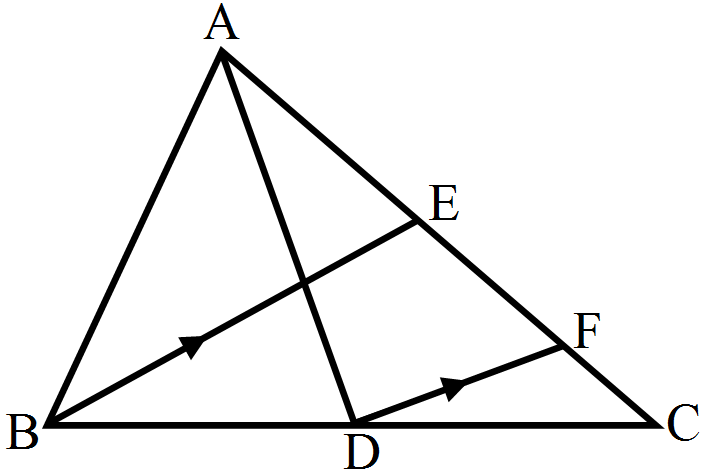
In the adjoining figure, AD and BE are the medians of $\triangle\text{ABC}$ and DF || BE. Show that $\text{CF}=\frac{1}{4}\text{AC}.$

Simplify the following expressions:
(x2 - x + 1)2 - (x2 + x + 1)2
In a parallelogram ABCD, if $\angle\text{A}=(3\text{x}-20)^\circ,\angle\text{B}=(\text{y}+15)^\circ,\angle\text{C}=(\text{x}+40)^\circ,$ then find the values of x and y.
Draw a line segment of length 10cm and bisect it. Further, bisect one of the equal parts and measure its length.
If both x + 1 and x - 1 are factors of ax3 + x2 - 2x + b, find the values of a and b.
Complete the following example using Nityasam.
$\begin{array}{c}(i)(2 a-7 b)^3=(2 a)^3+(-7 b)^3+3(2 a)(-7 b)(\_\_\_\_\_\_) \\ =\_\_\_\_\_\_+\left(-343 b^3\right)+(-42 a b)(2 a-7 b) \\ =8 a^3-\_\_\_\_\_\_\_-84 a^2 b+\_\_\_\_\_\_\end{array}$
$\begin{array}{c}(ii) 95 \times 105=(100+\_\_\_\_\_\_)\left(100-\_\_\_\_\_\_\right) \\ =(100)^2-(\_\_\_\_\_\_)^2 \\ =\_\_\_\_\_\_-\_\_\_\_\_\_\\=9975\end{array}$