Question
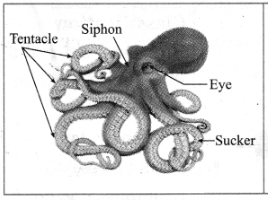
Sketch, labell and classify: Octopus

Answer


Image
Classification:
Kingdom: Animalia
Division: Non-chordata
Phylum: Mollusca
Example: Octopus

Need a full question paper?

Generate a complete, print-ready paper with questions like this in minutes — across 16+ boards, with answer keys.

Start Generating Free

Similar questions

If the absolute refractive index of water is $1.36$, find the speed of light in water. (Speed of light in vacuum $= 3 \times 10^8 m/s.$)
Metal $A$ burns in air, on heating, to form an oxide $A_2O_3$ whereas another metal $B$ burns in air only on strong heating to form an oxide $BO.$ The two oxides $A_2O_3$ and $BO$ can react with hydrochloric acid as well as sodium hydroxide solution to form the corresponding salts and water.
  1. What is the nature of oxide $A_2O_3?$
  2. What is the nature of oxide $BO?$
  3. Name one metal like $A.$
  4. Name one metal like $B.$
Two lamps, one rated $40W$ at $220V$ and the other 60W at $220V$, are connected in parallel to the electric supply at 220V.
  1. 10 Draw a circuit diagram to show the connections.
  2. Calculate the current drawn from the electric supply.
  3. Calculate the total energy consumed by the two lamps together when they operate for one hour.
What are Satellite Launch Vehicles? Explain a satellite launch vehicle developed by ISRO with help of systematic diagram.
X and Y are two human beings. The organ A in the reproductive system of X releases a mature gamete B once a month which goes into a tube-like structure C through a funnel-like opening. The organ D in the reproductive system of Y makes and releases gametes E which pass through a duct F and are introduced by an organ of Y, into the body of X. B and E fuse together in C to form a new cell G. The cell G divides repeatedly to form a ball of cells H which gets embedded in the lining of organ I of reproductive system of X where it grows and develops into a baby.
  1. Name (i) organ A, and (ii) gamete B.
  2. Write two names of tube-like structure C.
  3. Name (i) organ D, and (ii) gamete E.
  4. Write two names of duct F.
  5. Name (i) cell G (ii) ball of cells H, and (iii) organ I.
  6. Out of X and Y, which one is (i) male, and (ii) female?
The radius of planet $A$ is half the radius of planet $B$. If the mass of $A$ is $M_A,$ what must be the mass of $B$ so that the value of g on B is half that of its value on $A?$
An organism A which cannot move from one place to another, makes a simple food B from the substances C and D available in the environment. This food is made in the presence of a green coloured substance E present in organs F in the presence of light energy in a process called G. Some of the simple food B also gets converted into a complex food H for storage purposes. The food H gives a blue-black colour with dilute iodine solution.
  1. What is (i) organism A, (ii) food B and (iii) food H?
  2. What are C and D?
  3. Name (i) green coloured substance E, and (ii) organ F.
  4. What is the process G?
Explain the mechanism of photosynthesis.
Reproduction is the process by which the living species continues its existence. Lower organisms carry out asexual reproduction while higher plants and animals always show sexual reproduction. Plants reproduce asexually by methods such as fragmentation, vegetative propagation, budding, spore formation. For sexual reproduction they form gametes. In animal kingdom, budding, fission of different types and parthenogenesis are some of the methods that do not require both the sexes. Though regeneration also forms new individual, it is not considered to be a reproductive process because, basically it is a repair process. The ability to regenerate is lost in higher phyla. In human beings | it is restricted only to wound healing. Sexual reproduction is also undergoing lots of experimentation such as cloning which may make females capable of producing their own baby without intervention of any male.
Questions and Answers:
(1) How do living species continue their existence?
(2) Which are asexual methods of reproduction in kingdom Animalia?
(3) Why is regeneration not true method of reproduction?
(4) What are methods of reproduction in plants?
(5) What is the modern method of reproduction aimed at in higher organisms?
A metal salt $MX$ when exposed to light splits up to form metal $M$ and a gas $X_2.$ Metal M is used in making ornaments whereas gas $X_2$ is used in making bleaching powder. The salt $MX $ is itself used in black and white photography:
  1. What do you think metal M is?
  2. What could be gas $X_2?$
  3. Name the metal salt $MX.$
  4. Name any two salt solutions which on mixing together can produce a precipitate of salt $MX.$
  5. What type of chemical reaction takes place when salt MX is exposed to light? Write the equation of the reaction?