Question
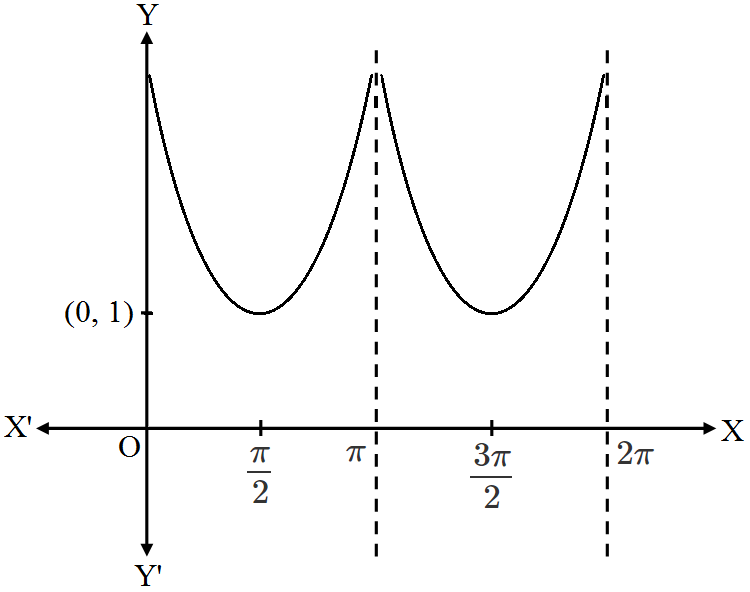
Sketch the graphs of the following functions:
$\text{f(x)}=\text{cosec}^2\text{x}$

Answer

$\text{f(x)}=\text{cosec}^2\text{x}$

Need a full question paper?

Generate a complete, print-ready paper with questions like this in minutes — across 16+ boards, with answer keys.
Start Generating Free

Similar questions

Evaluate the following limit:
$\lim\limits_{\text{x}\rightarrow{\frac{\pi}{4}}}\frac{\cos\text{x}-\sin\text{x}}{\big(\frac\pi4-\text{x}\big)(\cos\text{x}+\sin\text{x})}$
A manufacturer of radio sets produced $600$ units in the third year and $700$ units in the seventh year. Assuming that the product increases uniformly by a fixed number every year, find:
  1. The production in the first year.
  2. The total product in $7$ years and
  3. The product in the $10^{th}$ year.
Find the equation of a line perpendicular to the line $3x - y + 5 = 0$ and at a distance of $3$ units from the origin.
Find the equation of the straight line drawn through the point of intersection of the lines x + y = 4 and 2x - 3y = 1 and perpendicular to the line cutting off intercepts 5, 6 on the axes.
In each the following find the equation of the hyperbola satisfying the given conditions:
Foci $(\pm4, 0), $ latus-rectum = 12 [NCERT]
In a lottery, a person chosen, six different natural numbers at random from 1 to 20 and if these six numbers match with the six numbers already fixed by the lottery committee, he wins the prize. What is the probability of winning the prize in the game?
[Hint order of the numbers is not important.]
Evaluate the following limit:
$\lim\limits_{\text{x}\rightarrow-\infty}\big(\sqrt{4\text{x}^2-7\text{x}}+2\text{x}\big)$
If a, b, c, are in G.P., prove that:
$\big(\text{a}^2-\text{b}^2\big),\big(\text{b}^2-\text{c}^2\big),\big(\text{c}^2-\text{d}^2\big)\text{ are in G.P.}$
Evaluate the following limit:
$\lim\limits_{\text{x}\rightarrow0}\frac{\text{x}}{\sqrt{1+\text{x}}-\sqrt{1-\text{x}}}$
Prove that $\stackrel{{7+77+777+...+777\ ...................\ 7}}{ \ \ \ \ \ \ \ \ \ \ \ \ \ \ \ \ \ \ \ \ \ \ \hbox{ n-digits}}$ $$${ =\frac{7}{81}(10^{\text{n}+1}-9\text{n}-10)}$ for all $\text{n}\in\text{N}.$