Question
Sketch the magnetic field lines for a current-carrying circular loop near its centre. Replace the loop by an equivalent magnetic dipole and sketch the magnetic field lines near the centre of the dipole. Identify the difference.

Answer

As in loop magnetic field lines pass thorough the center but in case of magnet dipole the magnetic field lines does not pass through center or even meet at center point.

Need a full question paper?

Generate a complete, print-ready paper with questions like this in minutes — across 16+ boards, with answer keys.
Start Generating Free

Similar questions

What is refraction of light? Explain law of refraction.
Answer the following questions:
  1. Draw a graph showing variation of photocurrent with anode potential for a particular intensity of incident radiation. Mark saturation current and stopping potential.
  2. By how much would be stopping potential for a given photosensitive surface go up if the frequency of the incident radiations were to be increased from $4 \times 10^{15}\ Hz$ to $8 \times 10^{15}\ Hz$?
The bob of a simple pendulum of length 1m has mass 100g and a speed of 1.4m/s at the lowest point in its path. Find the tension in the string at this instant.
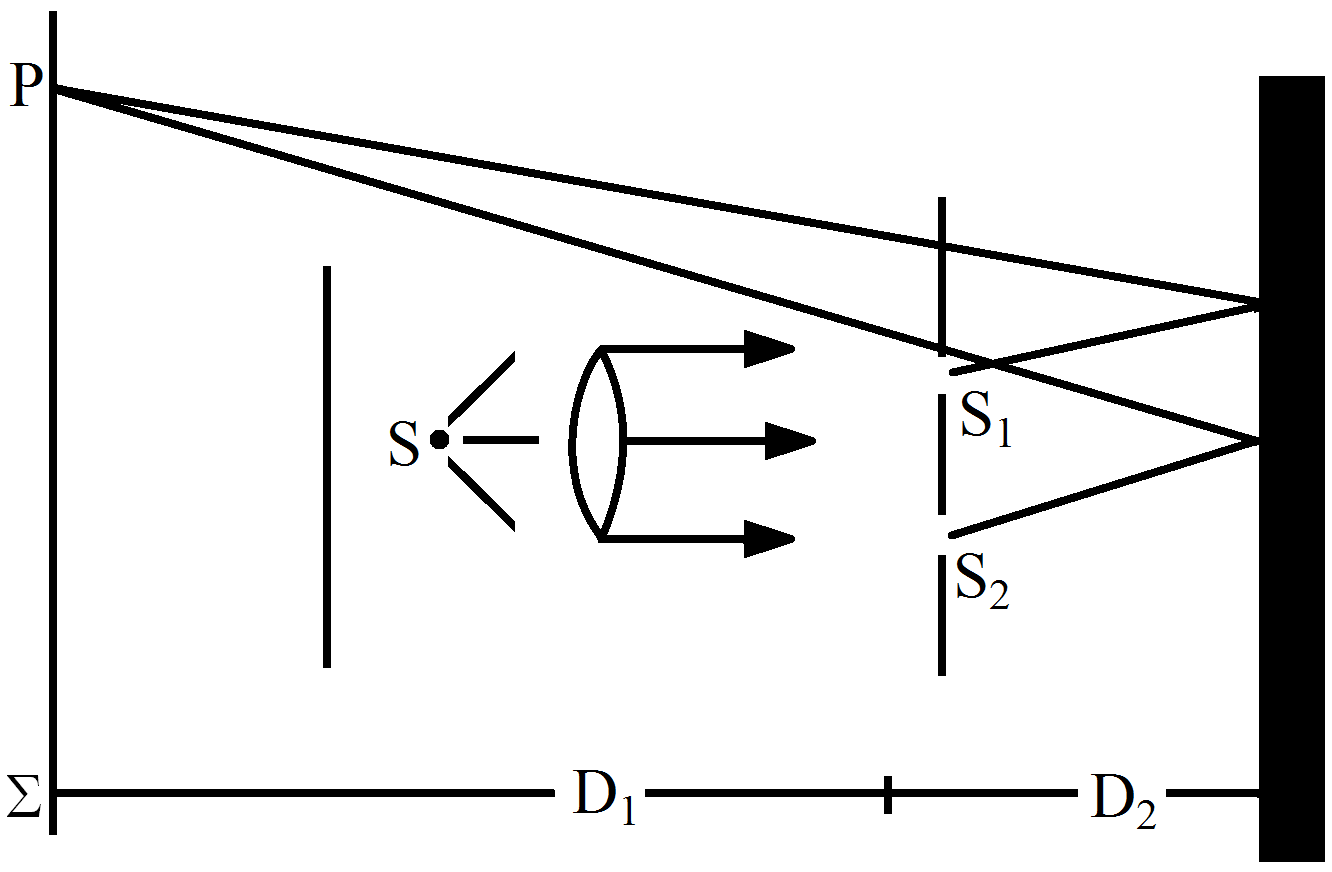
A double slit $S_1 - S_2$ is illuminated by a coherent light of wavelength $\lambda$. The slits are separated by a distance $d$. A plane mirror is placed in front of the double slit at a distance $D_1$ from it and a screen $\sum$ is placed behind the double slit at a distance $D_2$ from it $($figure $17-E_2)$. The screen $E$ receives only the light reflected by the mirror. Find the fringe$-$width of the interference pattern on the screen.
Draw $ৎ \rightarrow$ T graph for metals, alloys and semi conductor and explain.
Explain physical meaning of electric field.
An inductor is connected to a battery through a switch. Explain why the emf induced in the inductor is much larger when the switch is opened as compared to the emf induced when the switch is closed.
Write two properties of a material suitable for making (a) a permanent magnet, and (b) an electromagnet.
A spectroscopic instrument can resolve two nearby wavelengths $\lambda$ and $\lambda+\Delta\lambda$ if $\frac{\lambda}{\Delta\lambda}$ is smaller than 8000. This is used to study the spectral lines of the Balmer series of hydrogen. Approximately how many lines will be resolved by the instrument?
The magnetic field inside a tightly wound, long solenoid is $\text{B}=\mu_0\text{ni}.$ It suggests that the field does not depend on the total length of the solenoid, and hence if we add more loops at the ends of a solenoid the field should not increase. Explain qualitatively why the extra-added loops do not have a considerable effect on the field inside the solenoid.