MCQ
Sky wave propagation is based on :
  • reflection from ionosphere
  • B
    absorption by ionosphere
  • C
    transmission through ionosphere
  • D
    none of these

Answer

Correct option: A.
reflection from ionosphere
A

Need a full question paper?

Generate a complete, print-ready paper with questions like this in minutes — across 16+ boards, with answer keys.
Start Generating Free

Similar questions

A magnet is dropped down an infinitely long vertical copper tube(a) The magnet moves with continuously increasing velocity and ultimately acquires a constant terminal velocity (b) The magnet moves with continuously decreasing velocity and ultimately comes to rest(c) The magnet moves with continuously increasing velocity but constant acceleration(d) The magnet moves with continuously increasing velocity and acceleration


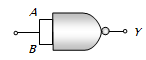
This symbol represents
In a permanent magnet at room temperature.
Light of wavelength $4000 \mathring A$  falls on a photosensitive metal and a negative $2V$ potential stops the emitted electrons. The work function of the material $($in $eV)$ is approximately $(h = 6.6 \left.\times 10^{-34} \mathrm{Js}, \mathrm{e}=1.6 \times 10^{-19} \mathrm{C}, \mathrm{c}=3 \times 10^8 \mathrm{~ms}^{-1}\right)$
The number of photo electrons emitted for light of a frequency $v\ ($higher than the threshold frequency $v_0​)$ is proportional to:
A small bar magnet A oscillates in a horizontal plane with a period $T$ at a place where the angle of dip is $60^{\circ}.$ When the same needle is made to oscillate in a vertical plane coinciding with the magnetic meridian, its period will be
An electron is moving towards x-axis. An electric field is along y-direction then path of electron is (a) Circular(b) Elliptical(c) Parabola(d) None of these
       
As the intensity of incident light increases(a) Photoelectric current increases(b) Photoelectric current decreases(c) Kinetic energy of emitted photoelectrons increases(d) Kinetic energy of emitted photoelectrons decreases


In Young's double slit experiment the $y-$coordinates of central maxima and $10^{\text {th}}$ maxima are $2 \ cm$ and $5 \ cm$ respectively. When the $\text{YDSE}$ apparatus is immersed in a liquid of refractive index $1.5$ the corresponding $y-$coordinates will be
The ratio of the energy of an $X-$ray photon of wavelength $1 \mathring A$ to that of visible light of wavelength $5000 \mathring A$ is