MCQ
SN1 reaction on optically active substrates mainly gives:
- ARetention in configuration
- BInversion in configuration
- CRacemic product
- DNo product
Explanation:
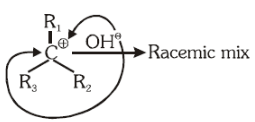
Since the nucleophile attacks the carbocation only after the leaving group has departed, in SN1, there is no need for back-side attack.
The carbocation and its substituents are all in the same plane (Figure 1), meaning that the nucleophile can attack from either side.
As a result, both enantiomers are formed in a SN1 reaction, leading to a racemic mixture of both enantiomers.
Generate a complete, print-ready paper with questions like this in minutes — across 16+ boards, with answer keys.
$I.$ All the chlorides are bonded by primary valency
$II.$ All the chlorides are bonded by secondary valency
$III.$ All the $NH_3$ are bonded by secondary valency
$IV.$ Half of the chlorides are bonded with secondary valency
$(A)$ Total number of valence shell electrons at metal centre in $Fe ( CO )_5$ or $Ni ( CO )_4$ is $16$
$(B)$ These are predominantly low spin in nature
$(C)$ Metal-carbon bond strengthens when the oxidation state of the metal is lowered
$(D)$ The carbonyl $C - O$ bond weakens when the oxidation state of the metal is increased