MCQ
SN1 reaction on optically active substrates mainly gives:
- ARetention in configuration
- BInversion in configuration
- CRacemic product
- DNo product
Explanation:
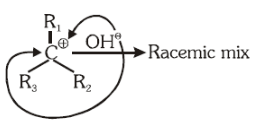
Since the nucleophile attacks the carbocation only after the leaving group has departed, in SN1, there is no need for back-side attack.
The carbocation and its substituents are all in the same plane (Figure 1), meaning that the nucleophile can attack from either side.
As a result, both enantiomers are formed in a SN1 reaction, leading to a racemic mixture of both enantiomers.
Generate a complete, print-ready paper with questions like this in minutes — across 16+ boards, with answer keys.