MCQ
Soap bubbles appear colored when seen in white light. The reason for this phenomenon is :
  • A
    Scattering
  • Interference
  • C
    Dispersion
  • D
    Diffraction.

Answer

Correct option: B.
Interference
(B) - Interference.

Need a full question paper?

Generate a complete, print-ready paper with questions like this in minutes — across 16+ boards, with answer keys.
Start Generating Free

Similar questions

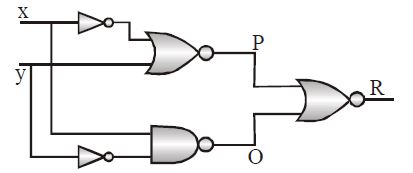
Figure gives a system of logic gates. From the study of truth table it can be found that to produce a high output $(1)$ at $R$, we must have
In a nuclear fission process, a high mass nuclide $(A \approx 236)$ with binding energy $7.6\  \mathrm{MeV} /$ Nucleon dissociated into middle mass nuclides $(A \approx 118)$, having binding energy of $8.6 \ \mathrm{MeV} / \mathrm{Nucleon}$. The energy released in the process would be $\mathrm{MeV}$.
A spherical portion has been removed from a solid sphere having a charge distributed uniformly in its volume as shown in the figure. The electric field inside the emptied space is
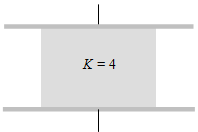
Consider a parallel plate capacitor of 10 μF (micro-farad) with air filled in the gap between the plates. Now one half of the space between the plates is filled with a dielectric of dielectric constant 4, as shown in the figure. The capacity of the capacitor changes to
For photoelectric emission from certain metal the cutoff frequency is $\nu$. If radiation of frequency $2\nu$ impinges on the metal plate, the maximum possible velocity of the emitted electron will be ($m$ is the electron mass)
When the particle and its anti$-$particle unite, the result is:
The time period of oscillation of a freely suspended bar magnet with usual notations is given by
Mass energy equation was propounded by:
A thin film of soap solution $(n = 1.4)$ lies on the top of a glass plate $(n = 1.5)$. When visible light is incident almost normal to the plate, two adjacent reflection maxima are observed at two wavelengths $420\,nm$ and $630\,nm$. The minimum thickness of the soap solution is.....$nm$
A convex lens and a concave lens, each having same focal length of $25\,\, cm,$ are put in contact to form a combination of lenses. The power in diopters of the combination is