Question
Soaps and detergents are both types of salts. State the difference between the two. Write the mechanism of the cleansing action of soaps. Why do soaps not form lather (foam) with hard water? Mention any two problems that arise due to the use of detergents instead of soaps.
Answer

The molecules of soap are sodium or potassium salts of long-chain carboxylic acids. Detergents are generally ammonium or sulphonate salts of long chain carboxylic acids.
Cleansing action of soap can be described as follows:
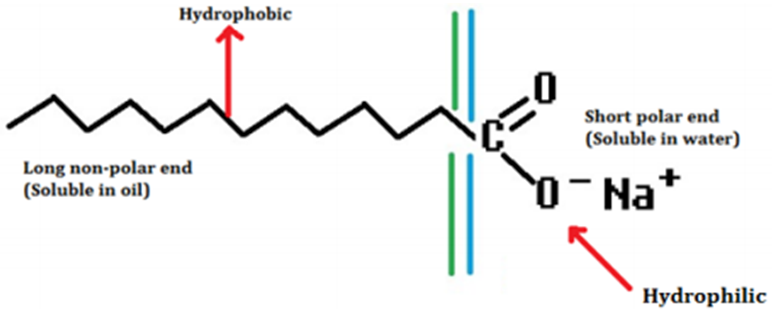
  1. A soap molecule has a tadpole-shaped structure.
  2. At one end (long non-polar end) of the soap molecule is a hydrocarbon chain which is insoluble in water but soluble in oil.
  3. At the other end (short polar end) of the soap molecule, there is a carboxylate ion which is hydrophilic, i.e. water soluble but insoluble in oil.

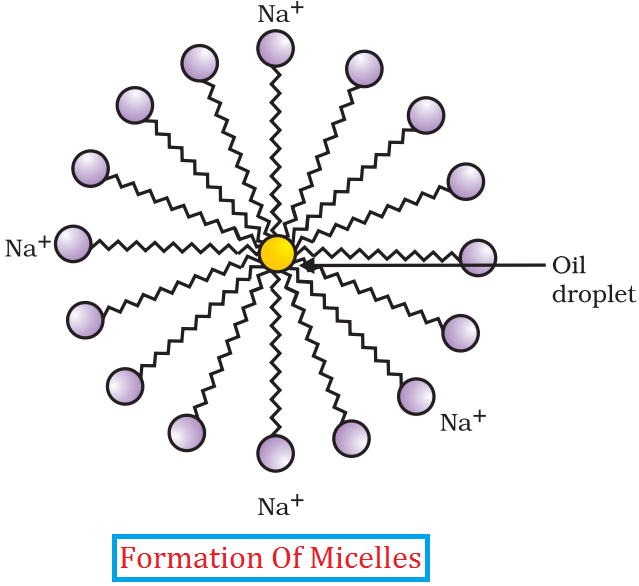
Soap on mixing with water forms a concentrated solution and causes foaming. The long non-polar end of soap gravitates towards and surrounds the dirt and absorbs the dust in it. The short polar end with the carboxylate ion repels the water away from the dirt. A spherical aggregate of soap molecules is formed in the soap solution in water and is called a micelle. Thus, the soap molecule dissolves the dirt and our clothes get clean.

Soaps do not form lather in hard water because Hard water contains calcium and magnesium salts. Soap molecules react with calcium and magnesium salts to form an insoluble precipitate called scum.
Two problems arise because of the use of detergents instead of soap:
  1. Soaps are biodegradable, while detergents are non-biodegradable; hence, detergents accumulate in the environment and cause problems.
  2. Certain phosphate additives are added to detergents. These phosphate additives act as nutrients for algae which form a thick green scum over the river water and upset the animal life in the river.

Need a full question paper?

Generate a complete, print-ready paper with questions like this in minutes — across 16+ boards, with answer keys.

Start Generating Free

Similar questions

How will you infer with the help of an experiment that the same current flows through every part of the circuit containing three resistances in series connected to a battery?
Define pollination. Explain the different types of pollination. List two agents of pollination? How does suitable pollination lead to fertilization?
Explain the difference between each of the following pairs of terms:
  1. Receptor and effector.
  2. Cerebrum and cerebellum.
In the artificial kidneys, the tubes are all with semi-permeable lining. Why?
When hydrogen is passed over copper oxide, copper and steam are formed. Write a balanced equation for this reaction and state which of the chemicals are:
  1. Elements.
  2. Compounds.
  3. Reactants.
  4. Products.
  5. Metals.
  6. Non-metals.
Why is there a need for harnessing non-conventional sources of energy? How can energy be harnessed from the sea in different ways?
When an object made of metal A is kept in air for a considerable time, it loses its shine and becomes almost black due to the formation of a layer of substance B. When an object made of another metal C is kept in damp air for a considerable time, it gets covered with a green layer of substance D. Metal A is the best conductor of electricity whereas metal C is the next best conductor of electricity.
  1. What is metal A?
  2. What is metal C?
  3. Name the substance B.
  4. Name the substance D.
  5. What type of chemical can be used to remove the green layer from metal C and clean it? Why?
A scientist removed some cells from the growing point of a plant and placed it in a suitable medium leading to the formation of a shapeless lump of mass X. X is then transferred to another medium which stimulates it to develop roots. When X with developed roots is placed in a yet another medium, then it develops shoots to form tiny plantlets. These plantlets can then be transplanted in pots or soil where they can grow to form mature plants.
  1. What is the shapeless lump of mass X known as?
  2. What name is given to this method of producing new plants?
  3. The growth medium used in this method contains plant nutrients in the form of a 'jelly'. Name this jelly.
  4. What is the general name of chemicals used to stimulate the growth of plant cells and development of roots and shoots?
  5. Name any two plants which are produced by this method.
  6. State any two advantages of this method of producing plants.
  7. What is the other name of this method [other then that given in (b) above]?
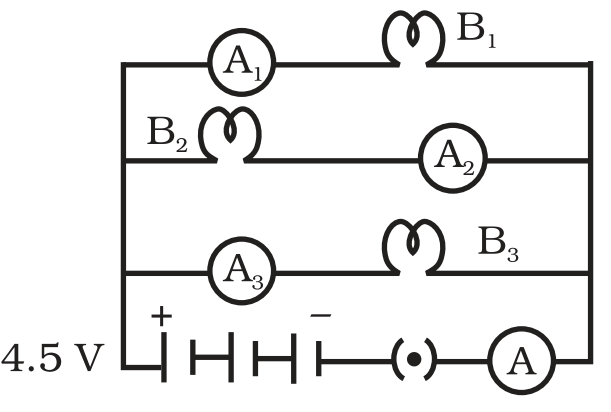
$B_1, B_2$ and $B_3$ are three identical bulbs connected as shown in Figure. When all the three bulbs glow, a current of 3 A is recorded by the ammeter A
.
i. What happens to the glow of the other two bulbs when the bulb $B_1$ gets fused?
ii. What happens to the reading of $A_1, A_2, A_3$ and $A$ when the bulb $B_2$ gets fused?
iii. How much power is dissipated in the circuit when all the three bulbs glow together?
What are the main uses of coal and petroleum products?