MCQ
Sodium chloride crystal has a $.....$ shape:
  • Definite
  • B
    Regular
  • C
    Irregular
  • D
    None of these

Answer

Correct option: A.
Definite
In $\text{NaCl}$ crystal, there exists strong ionic bonding between $\mathrm{Na}^{+}$ and $\mathrm{Cl}^{-}$ions. Because of stronger forces of attraction between $\mathrm{Na}^{+}$ and $\mathrm{Cl}^{-}$, they remain fixed at their positions, thus, arranging in a definite pattern to give a definite shape.

Need a full question paper?

Generate a complete, print-ready paper with questions like this in minutes — across 16+ boards, with answer keys.
Start Generating Free

Similar questions

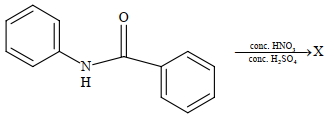
In the following reaction, $Image$ the structure of the major product ' $X$ ' is
The hypothetical reaction : $2A + B \to C + D$ is catalyzed by $E$ as indicated in the possible mechanism below -

Step$-1$ : ${\text{A  +  E }} \rightleftharpoons AE$ (fast)

Step$-2$ :${\text{AE  +  A }} \to {A_2} + E$ (slow)

Step$-3$ :${{\text{A}}_2}{\text{ +  B }} \to {\text{D}}$ (fast)

what rate law best agrees with this mechanism

“The relative lowering of the vapour pressure is equal to the mole fraction of the solute.” This law is called
$2.5\, g$ of protein containing only glycine $\left( C _{2} H _{5} NO _{2}\right)$ is dissolved in water to make $500 \,mL$ of solution. The osmotic pressure of this solution at $300\, K$ is found to be $5.03 \times 10^{-3}$ $bar.$ The total number of glycine units present in the protein is $....$

(Given : $R =0.083\, L\, bar \,K ^{-1} \,mol ^{-1}$ )

The crystal field stabilisation energy of $[Co(NH_3)_6]Cl_3$ is .........$\, \Delta_0$
Arrange the following compounds in increasing order of basicity$:\ \mathrm{CH}_3 \mathrm{NH}_2,\left(\mathrm{CH}_3\right)_2 \mathrm{NH}, \mathrm{NH}_3, \mathrm{C}_6 \mathrm{H}_5 \mathrm{NH}_2$​
Which of the following statements is not valid for oxoacids of phosphorus ?
Glucose forms many derivatives. The derivative which will help to prove the furanose structure is
Reduction of nitroalkanes yields
Zinc forms two important alloys, $(i)$  Brass and $ (ii) $ German silver. Metals present in them mainly are