MCQ
Solid $Ba(NO_3)_2$ is gradually dissolved in $1\times10^{-4}\, M\, Na_2CO_3$ solution. At what concentration of $Ba^{+2}$ the precipitation of $BaCO_3$ will start? (If $K_{sp}$ of $BaCO_3 = 5.1\times10^{-9}$)
  • A
    $4.1\times10^{-5}\, M$
  • $5.1\times10^{-5}\, M$
  • C
    $1.6\times10^{-4}\, M$
  • D
    $8.1\times10^{-7}\, M$

Answer

Correct option: B.
$5.1\times10^{-5}\, M$
b
$\left[\mathrm{Ba}^{+2}\right]\left(10^{-4}\right)=5.1 \times 10^{-9}$

$\boxed{\left[ {{\text{B}}{{\text{a}}^{ + 2}}} \right] = 5.1 \times {{10}^{ - 5}}{\mkern 1mu} {\text{M}}}$

Need a full question paper?

Generate a complete, print-ready paper with questions like this in minutes — across 16+ boards, with answer keys.

Start Generating Free

Similar questions

What quantity of ammonium sulphate is necessary for the production of $N{H_3}$ gas sufficient to neutralize a solution containing $292\, g$ of $HCl$?.............. $\mathrm{g}$

$[HCl=36.5; {(N{H_4})_2}S{O_4}=132; N{H_3}=17]$

Molecules are held together by which type of bonds?
The heat of transition $(\Delta {H_t})$ of graphite into diamond would be, where$C({\rm{graphite}}) + {O_2}(g) \to C{O_2}(g);\,\,\Delta H = x\,kJ$ $C({\rm{diamond}})\, + {O_2}(g) \to C{O_2}(g);\,\,\Delta H = y\,kJ$
Graphite cleaves easily between the layers. Thus, it is :
The reaction of toluene with chlorine in the presence of light gives
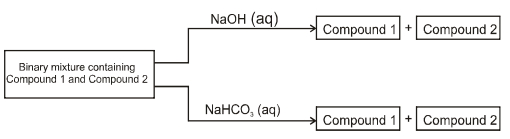
Identify the binary mixture$(s)$ that can be separated into individual compounds, by differential extraction, as shown in the given scheme.

$(A)$ $C _6 H _5 OH$ and $C _6 H _5 COOH$

$(B)$ $C _6 H _5 COOH$ and $C _6 H _5 CH _2 OH$

$(C)$ $C _6 H _5 CH _2 OH$ and $C _6 H _5 OH$

$(D)$ $C _6 H _5 CH _2 OH$ and $C _6 H _5 CH _2 COOH$

At ${27\,^o}C,$ one mole of an ideal gas is compressed isothermally and reversibly from a pressure of $2 $ atm to $10 $ $atm$. The values of $\Delta E$ and $q $ are $(R = 2)$
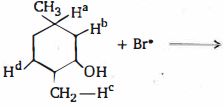
$Br^\bullet $ will abstract which of the hydrogen most readily ?
The  $pH$ of $0.1\,M\,NaOH$ is
${H_2}{C_2}{O_4}\left( B \right)\xrightarrow{\Delta }gas\left( A \right) + gas\left( B \right) + liquid\left( C \right)$,

$Gas$ $(A)$ bums with a blue flame and is oxidised to $gas$ $(B)$, 

$Gas\left( A \right) + C{l_2} \to \left( D \right)\xrightarrow{{N{H_3},\Delta }}\left( E \right)$. 

$A,B, C$ and $E$ are