Question
Solve : 15x + 17y = 21; 17x + 15y = 11

Need a full question paper?

Generate a complete, print-ready paper with questions like this in minutes — across 16+ boards, with answer keys.
Start Generating Free

Similar questions

Two arithmetic progression have the same common difference. The difference between their $100^{\text {th }}$ terms is $100$ , What is the difference between their $1000^{\text {th }}$ terms?
If the point $P(k - 1, 2)$ is equidistant from the points $A(3, k)$ and $B(k, 5)$, find the values of $k$.
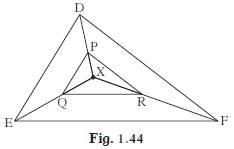
In the figure 1.44, X is any point in the interior of triangle. Point X is joined to vertices of triangle. Seg PQ || seg DE, seg QR || seg EF. Fill in the blanks to prove that, seg PR || seg DF.

Proof: IN $\triangle XDE , PQ \| DE$ $\square$
$\therefore \frac{ XP }{\square}=\frac{\square}{ QE }$
(Basic proportionality theorem)
In $\triangle XDE , QR \| EF......... \square$
$\therefore$ $\frac{\square}{\square}=\frac{\square}{\square}...............(ii)\square$
$\therefore$ $\frac{\square}{\square}=\frac{\square}{\square}...............$ from (i) and (ii)
$\therefore \text { seg PR\|seg DE .......... }$
(converse of basic proportionality theorem)
Find the value of $k$ for which given quadratic equation are real and equal roots.
$4 x^2-3 k x+1=0$
In $\triangle\text{ABC},$ P and Q are points on sides AB and AC respectively such that PQ || BC. If AP = 3cm, PB = 5cm and AC = 8cm, find AQ.
Prove the following.
$\frac{\tan \theta}{\sec \theta+1}=\frac{\sec \theta-1}{\tan \theta}$
Find the area of the sector of a circle of radius $5\ cm$, if the corresponding arc length is $3.5\ cm$.
Prove that the points (3, 0), (4, 5), (-1, 4) and (-2, -1), taken in order, form a rhombus. Also, find its area.
The difference of squares of two number is $88$. If the larger number is $5$ less than twice the smaller number, then find the two numbers.