Question
Solve: $6x + 3y = 7xy$ and $3x + 9y =11xy$.

Answer

The given equations are as follow:
$6x + 3y = 7xy ...(i)$
$3x + 9y = 11 ....(ii)$
For equation (i), we have:
$\frac{6\text{x}+3\text{y}}{\text{xy}}=7$
$\frac{6\text{x}}{\text{xy}}+\frac{3\text{y}}{\text{xy}}=7$
$\frac{6\text{}}{\text{y}}+\frac{3\text{}}{\text{x}}=7...(\text{iii})$
For equation (ii), we have:
$\frac{3\text{x}+9\text{y}}{\text{xy}}=11$
$\frac{3\text{x}}{\text{xy}}+\frac{9\text{y}}{\text{xy}}=11$
$\frac{3\text{}}{\text{y}}+\frac{9\text{}}{\text{x}}=11...(\text{iv})$
On Substituting $\frac{1}{\text{y}}=\text{v}$ and $\frac{1}{\text{x}}=\text{u}$ in $(iii)$ and $(iv)$, we get:
$6v + 3u = 7 ...(v)$
$3v + 9u = 11 ....(vi)$
On multipiying $(v)$ by $3$, We get:
$18v + 9u = 21 ....(vii)$
On subtracting $(vi)$ from $(vii)$, we get:
$15v = 10$
$\Rightarrow\text{v}=\frac{10}{15}=\frac{2}{3}$
$\Rightarrow\frac{1}{\text{y}}=\frac{2}{3}$
$\Rightarrow\text{y}=\frac{3}{2}$
On subtracting $\text{y}=\frac{3}{2}$ in $(iii)$, we get:
$\frac{6}{\frac{3}{2}}+\frac{3}{\text{x}}=7$
$\Rightarrow4+\frac{3}{\text{x}}=7$
$\Rightarrow\frac{3}{\text{x}}=3$
$\Rightarrow3\text{x}=3$
$\Rightarrow\text{x}=1$
Hence, the required solution is $x = 1$ and $\text{y}=\frac{3}{2}$

Need a full question paper?

Generate a complete, print-ready paper with questions like this in minutes — across 16+ boards, with answer keys.
Start Generating Free

Similar questions

Solve the following quadratic equation:
$\text{x}^2-3\sqrt3-30=0$
How many revolutions $a$ circular wheel of radius $r$ metres makes in covering $a$ distance of $s$ metres?
Which term of the AP: $121, 117, 113, ....$is its first negative term?
[Hint: Find n for $a_n < 0$]
In the following, determine whether the given quadratic equation have real root and if so, find the root:
$ 3 x^2-2 x+2=0 $
Prove that $7 \sqrt { 5 }$ is irrational.
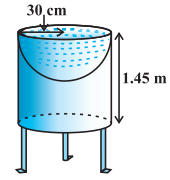
Mayank made a bird-bath for his garden in the shape of a cylinder with a hemispherical depression at one end (see Fig.). The height of the cylinder is $1.45\ m$ and its radius is $30\ cm$. Find the total surface area of the bird-bath.
(Take $\pi = \frac{22}{7}$ )
Which of the following sequences are arithmetic progressions. For those which are arithmetic progressions, find out the common difference.
$p, p + 90, p + 80, p + 270, ..... $ where $p = (999)^{999}$
On comparing the ratios $ \frac { a _ { 1 } } { a _ { 2 } } , \frac { b _ { 1 } } { b _ { 2 } } $ and $\frac { c _ { 1 } } { c _ { 2 } }$, find out whether the pair of linear equations are consistent, or inconsistent: $3x + 2y = 5, 2x − 3y = 7.$
The sides of certain triangles are given below. Determine which of them are right triangles.
$a = 16\ cm, b = 3.8\ cm$ and $c = 4\ cm.$
A cottage industry produces a certain number of toys in a day. The cost of production of each toy (in rupees) was found to be $55$ minus the number of articles produced in a day. On a particular day, the total cost of production was $Rs. 750$. If $x$ denotes the number of toys produced that day, from the quadratic equation of find $x.$