Question
Solve and graph the solution set on a number line : $\frac{2}{3} \mathrm{x}+5 \leq \frac{1}{2} \mathrm{x}+6 ; \mathrm{x} \in \mathrm{W}$
Answer

$\frac{2}{3} x+5 \leq \frac{1}{2} x+6$
$\Rightarrow \frac{2}{3} \mathrm{x} \times 6+5 \times 6 \leq \frac{1}{2} \mathrm{x} \times 6+6 \times 6 \ldots ($Multiplying both sides by $6 )$
$\Rightarrow 4 x+30 \leq 3 x+36$
$\Rightarrow 4 x-3 x+30 \leq 3 x-3 x+36 \ldots($ Substracting $3 x$ from both sides$)$
$\Rightarrow x+30 \leq 36$
$\Rightarrow x+30-30 \leq 36-30 \ldots ($Substracting $30$ from both sides$)$
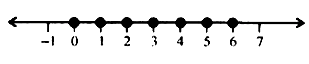
$x \leq 6$
$\therefore$ The required graph is:

Need a full question paper?

Generate a complete, print-ready paper with questions like this in minutes — across 16+ boards, with answer keys.


Start Generating Free

Similar questions

A sum of $Rs. 8,000$ is invested for $2$ years at $10\%$ per annum compound interest. Calculate : $(i)$ interest for the first year.$(ii)$ principal for the second year. $(iii)$ interest for the second year. $(iv)$ the final amount at the end of the second year $(v)$ compound interest earned in $2$ years.
Draw a line segment $AB$ of length $5.3 \ cm$. Using two different methods bisect $AB.$
Construct angle $ABC = 45^\circ$ in which $BC = 5 \ cm$ and $AB = 4.6 \ cm.$
In each of the following, draw perpendicular through point $P$ to the line segment $AB$ :
$(i)$

$(ii)$​​​​​​​
Image
$(iii)$​​​​​​​

Image
Solve : $\frac{4-3 x}{5}+\frac{7-x}{3}+4 \frac{1}{3}=0$ Hence, find the value of ' $p$ ', if $3 p-2 x+1=0$
In the following diagram, the bisectors of interior angles of the parallelogram $\text{PQRS}$ enclose a quadrilateral $\text{ABCD}.$

Show that :$ (i)\  \angle PSB + \angle SPB = 90^\circ\  (ii)\   \angle PBS = 90^\circ\  (iii)\  \angle ABC = 90^\circ \ (iv)\  \angle ADC = 90^\circ\  (v)\  \angle A = 90^\circ \ (vi)\  ABCD$ is a rectangle Thus, the bisectors of the angles of a parallelogram enclose a rectangle.
The floor of a rectangular hall has a perimeter $250\  m$. If the cost of painting the four walls at the rate of $₹ 10\  per\  m^2$ is ₹. $15,000,$ find the height of the hall.
Construct a square, if : its each side is $4.3 \ cm.$
A can finish a piece of work in $15$ days and $B$ can do it in $10$ days. They worked together for $2$ days and then $B$ goes away. In how many days will $A$ finish the remaining work?
$A$ and $B$ complete a piece of work in $24$ days. $B$ and $C$ do the same work in $36$ days; and $A, B$, and $C$ together finish it in $18$ days. In how many days will : $(i)\  A$ alone, $(ii)\  C$ alone,$\ (iii)\  A$ and $C$ together, complete the work?