MCQ
solve $\frac{{1 - \left| x \right|}}{{2 - \left| x \right|}} \ge 0$
  • A
    $R$
  • B
    $\left[ { - 1\,,\,2} \right)\,\, \cup \,\left( {2\,,\,\infty } \right)\,$
  • C
    $\left[ { - 1\,,\,1} \right]\,\, \cup \,\left( {2\,,\,\infty } \right)\,$
  • $\left( { - \infty ,\, - 2} \right)\,\, \cup \,\,[ - 1,\,1]\,\, \cup \,\,(2,\infty )$
Answer

Correct option: D.
$\left( { - \infty ,\, - 2} \right)\,\, \cup \,\,[ - 1,\,1]\,\, \cup \,\,(2,\infty )$
d

Need a full question paper?

Generate a complete, print-ready paper with questions like this in minutes — across 16+ boards, with answer keys.

Start Generating Free

Similar questions

Let $g(x) = 2 f (x/2) + f (1 - x)$ and $f (x) < 0$ in $0 \le x \le 1$ then $g(x)$
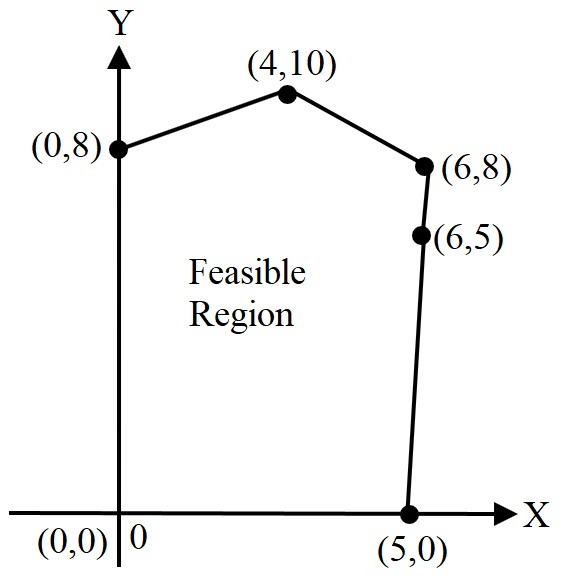
The feasible, region for an LPP is shown shaded in the figure. Let Z = 3x - 4y be the objective function. A minimum of Z occurs at:

Find the value of $\int \frac{\sin ^2 x-\cos ^2 x}{\sin ^2 x \cos ^2 x} d x$.
If $\vec{\text{a}} $ lies in the plane of vectors $\vec{\text{b}}$ and $\vec{\text{c}},$ then which of the following is correct?

  1. $\big[\vec{\text{a}}\vec{\text{b}}\vec{\text{c}}\big]=0$

  2. $\big[\vec{\text{a}}\vec{\text{b}}\vec{\text{c}}\big]=1$

  3. $\big[\vec{\text{a}}\vec{\text{b}}\vec{\text{c}}\big]=3$

  4. $\big[\vec{\text{b}}\vec{\text{c}}\vec{\text{a}}\big]=1$

If the directions cosines of a line are A, k, k, then:
The general solution of the differential equation $\frac{{dy}}{{dx}} = \frac{{{x^2}}}{{{y^2}}}$ is
To write the dual; it should be ensured that
  1.  All the primal variables are non - negative.
  2. All the bi values are non - negative.
  3. All the constraints are $\leq$ type if it is maximization problem and $\geq$ type if it is a minimization problem.
  1. I and II
  2. II and III
  3. I and III
  4. I, II and IIl
The value of the definite integral, $\int\limits_0^{100} {\frac{x}{{{e^{{x^2}}}}}\,dx} $ is equal to
Let $f:(1,3) \rightarrow \mathrm{R}$ be a function defined by

$f(\mathrm{x})=\frac{\mathrm{x}[\mathrm{x}]}{1+\mathrm{x}^{2}},$ where $[\mathrm{x}]$ denotes the greatest

integer $\leq \mathrm{x} .$ Then the range of $f$ is

Let $\text{f(x)}=|\sin\text{x}|.$ then,
  1. f(x) is everywhere differentiable.
  2. f(x) is everywhere continuous but not differentiable at $\text{x}=\text{n}\pi,\text{n}\in\text{Z}$
  3. f(x)  is everywhere continuous but not differentiable at $\text{x}=(2\text{n}+1)\frac{\pi}{2},\text{n}\in\text{Z}.$
  4. None of these.