Question
Solve equation using factorisation method:
$4(2x - 3)^2 - (2x - 3) - 14 = 0$

Answer

$4(2 x-3)^2-(2 x-3)-14=0$
$\text { Let } 2 x-3=y$
$\text { then } 4 y^2-y-14=0$
$\Rightarrow 4 y 2-8 y+7 y-14=0$
$\Rightarrow 4 y(y-2)+7(y-2)=0$
$\Rightarrow(y-2)(4 y+7)=0$
$\text { If } y-2=0 \text { or } 4 y+7=0$
$\Rightarrow y=2 \text { or } y=\frac{-7}{4}$
$\Rightarrow 2 x-3=2 \text { or } 2 x-3=\frac{-7}{4}$
$\Rightarrow 2 x=5 \text { or } 2 x=\frac{5}{4}$
$\Rightarrow x=\frac{2}{5} \text { or } x =\frac{5}{8}$

Need a full question paper?

Generate a complete, print-ready paper with questions like this in minutes — across 16+ boards, with answer keys.

Start Generating Free

Similar questions

The following distribution represents the height of 160 students of a school.

 
Height (in cm) No. of Students
140 – 145 12
145 – 150 20
150 – 155 30
155 – 160 38
160 – 165 24
165 – 170 16
170 – 175 12
175 – 180 8

Draw an ogive for the given distribution taking 2 cm = 5 cm of height on one axisand 2 cm = 20 students on the other axis. Using the graph, determine:
(1) The median height.
(2) The interquartile range.
(3) The number of students whose height is above 172 cm.
Five years ago, a woman’s age was the square of her son’s age. Ten years later her age will be twice that of her son’s age. Find:
The present age of the woman.
If $\frac{b y+c z}{b^2+c^2}=\frac{c z+a x}{c^2+a^2}=\frac{a x+b y}{a^2+b^2}$ then show that each ratio is equal to $\frac{x}{a}=\frac{y}{b}=\frac{z}{c}$.
If $a : b = c : d$, show that $(a - c) b^2 : (b - d) cd = (a^2 - b^2 - ab) : (c^2 - d^2 - cd)$.
When $x^3 + 3x^2 – mx + 4$ is divided by $x – 2,$ the remainder is $m + 3.$ Find the value of $m.$
Simplify: $\frac{\sin A}{\cot A+\operatorname{cosec} A}-\frac{\sin A}{\cot A-\operatorname{cosec} A}$
Solve the following equation by using quadratic formula and give your answer correct to 2 decimal places :$ 4x^2 – 5x – 3 = 0$
Find the equation of the line with x-intercept $5$ and a point on it $(-3, 2)$
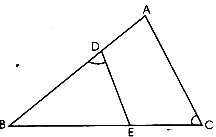
In the given figure ABC is a triangle with $\angle EDB = \angle ACB.$
(i) Prove that $\triangle ABC \sim \triangle EBD.$
(ii) If $BE = 6 cm, EC = 4 cm, BD = 5 cm$ and area of $\triangle BED = 9 cm^2.$
 Calculate the length of $AB$ and area of $\triangle ABC.$
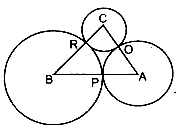
$ABC$ is a triangle with $AB = 10 cm, BC = 8 cm$ and $AC = 6 cm$ (not drawn to scale). Three circles are drawn touching each other with the vertices as their centres. Find the radii of the three circles.