Question
Solve for $x$ and $y$:
$0.4x + 0.3y = 1.7,$
$0.7x - 0.2y = 0.8$.

Answer

The given equations are:
$0.4x + 0.3y = 1.7 ...(i)$
$0.7x - 0.2y = 0.8 ...(ii)$
Multiply $(i)$ by $0.2$ and $(ii)$ by $0.3$ add them
$\Rightarrow 0.8x + 2.1x = 3.4 + 2.4$
$\Rightarrow 2.9x = 5.8$
$\Rightarrow x = 2$
Substitute $x = 2$ in $(i)$, we get
$\Rightarrow 0.4(2) + 0.3y = 1.7$
$\Rightarrow y = 3$
So, $x = 2$ and $y = 3$.

Need a full question paper?

Generate a complete, print-ready paper with questions like this in minutes — across 16+ boards, with answer keys.
Start Generating Free

Similar questions

State Euclid's division lemma.
What is the nature of root of the quadratic equation $ 4 x^2-12 x-9=0 $.
$\triangle\text{ABD}$ is a right triangle right-angled at $A$ and $\text{AC}\perp\text{BD}.$ Show that
$\frac{\text{AB}^2}{\text{AC}^2}=\frac{\text{BD}}{\text{DC}}$
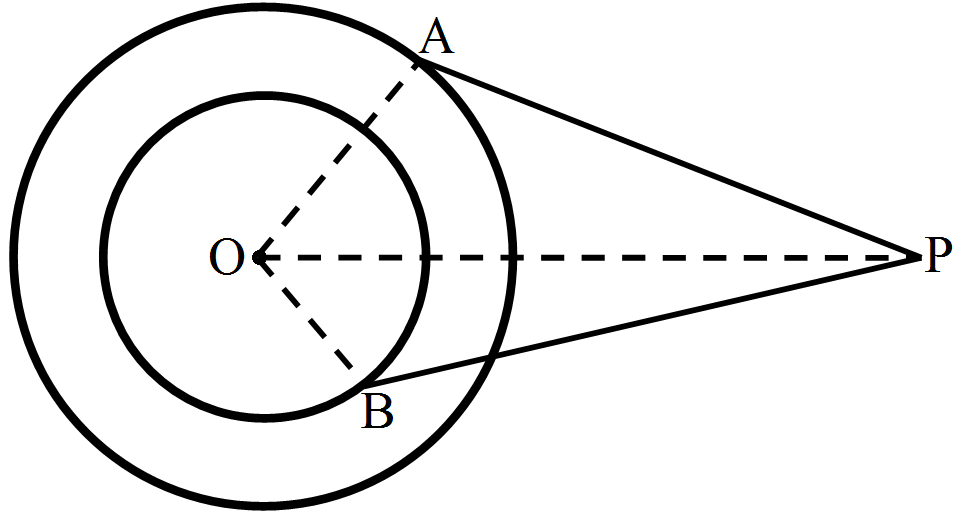
In the given figure, $O$ is the center of two concentric circle of radii $4\ cm$ and $6\ cm$ respectively. $PA$ and $PB$ are tangle to the outer and inner circle respectively. If $PA = 10\ cm$, find the length of $PB$ up to one place of decimal.
What is the angle subtended at the centre of a circle of radius $6\ cm$ by an arc of length $3\pi\text{ cm}?$
One card is drawn from a well-shuffled deck of $52$ cards. Calculate the probability that the card will
  1. be an ace,
  2. not be an ace.
A bag contains a red ball, a blue ball and a yellow ball, all the balls being of the same size. Kritika takes out a ball from the bag without looking into it. What is the probability that she takes out the
  1. yellow ball?
  2. red ball?
  3. blue ball?
A boy is cycling in such a way that the wheels of his bicycle. are making $140$ revolutions per minute. If the diameter of a wheel is $60\ cm$ calculate the speed (in km/hr) at which th boy is cycling.$\Big[\text{Use }\pi=\frac{22}{7}\Big]$
A cow is tied with a rope of length $14m$ at the corner of a rectangular field of dimensions $20m \times 16m$, find the area of the field in which the cow can graze.
Why is tossing a coin considered to be a fair way of deciding which team should choose ends in a game of cricket$?$