Question
Solve for x and y:
3x - 5y - 19 = 0,
-7x + 3y + 1 = 0

Answer

The given equation are: 3x - 5y - 19 = 0 ...(1) -7x + 3y + 1 = 0 ...(2) On multiplying (1) by 3 and (2) by 5, we get: 9x - 15y = 57 ...(3) -35x + 15y = -5 ...(4) On adding (3) and (4), we get: -26x = 52⇒ x = -2
On substituting the value of x = -2 in (1), we get: 3 × (-2) - 5y = 19⇒ -6 - 5y = 19
-5y = 19 + 6
⇒ -5y = 25 y = -5 $\therefore$ Solution is x = -2 and y = -5

Need a full question paper?

Generate a complete, print-ready paper with questions like this in minutes — across 16+ boards, with answer keys.
Start Generating Free

Similar questions

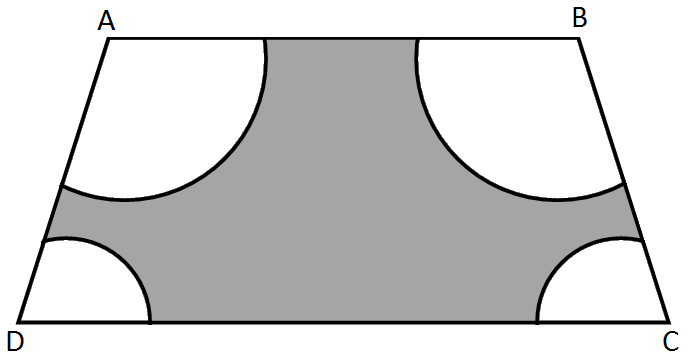
In the given figure, ABCD is a trapezium with $\text{AB}||\text{DC},\text{AB}=18\text{cm}$ DC = 32cm and the distance between AB and DC is 14cm. Circles of equal radii 7cm with centres A, B, C and D have been drawn. Then find the area of the shaded region.$\Big(\text{Use }\pi=\frac{22}{7}\Big)$
In $\triangle\text{ABC},$ P divides the side AB such that AP : PB = 1 : 2. Q is a point in AC such that PQ || BC. Find the ratio of the areas of $\triangle\text{APQ},$ and trapezium BPQC.
Prove that: $\frac{1}{\operatorname{cosec} A-\cot A}-\frac{1}{\sin A}=\frac{1}{\sin A}-\frac{1}{\operatorname{cosec} A+\cot A}$.
The product of two successive integral multiples of $5$ is $300$. Determine the multiples.
In the following, find the value of k for which the given value is a solution of the given equation:
$7\text{x}^2+\text{kx}-3=0,$ $\text{x}=\frac{2}{3}$
Show that $2-\sqrt{3}$ is an irrational number.
Find the smallest number which when increased by $17$ is exactly divisible by both $520$ and $468.$
The marks obtained out of $50$, by $102$ students in a Physics test are given in the frequency table below:
Marks (x)
$15$
$20$
$22$
$24$
$25$
$30$
$33$
$38$
$45$
Frequncy (f)
$5$
$8$
$11$
$20$
$23$
$18$
$13$
$3$
$1$
Find the average number of marks.
In the following, determine whether the given quadratic equation have real root and if so, find the root:
$3\text{x}^2+2\sqrt{5}\text{x}-5=0$
In which of the following situations, the sequence of numbers formed will form an A.P.?
Divya deposited Rs. $1000 $at compound interest at the rate of $10 \%$ per annum. The amount at the end of first year, second year, third year, ......... and so on.