Question
Solve: $\frac{3 x-2}{3}+\frac{2 x+3}{2}=x+\frac{7}{6}$

Answer

$ \frac{3 x-2}{3}+\frac{2 x+3}{2}=x+\frac{7}{6}$
$ \Rightarrow \frac{2(3 x-2)+3(2 x+3)}{6}=x+\frac{7}{6}$
$ \Rightarrow \frac{6 x-4+6 x+9}{6}=\frac{6 x+7}{6}$
$ \Rightarrow \frac{12 x+5}{6}=\frac{6 x+7}{6}$
$ \Rightarrow 6(12 x+5)=6(6 x+7)$
$ \Rightarrow 72 x+30=36 x-42$
$ \Rightarrow 72 x-36 x=42-30$
$ \Rightarrow 36 x=12$
$ x=\frac{12}{36}$
$ \therefore \frac{1}{3}$

Need a full question paper?

Generate a complete, print-ready paper with questions like this in minutes — across 16+ boards, with answer keys.

Start Generating Free

Similar questions

The breadth and height of a rectangular solid are $1.20\  m$ and $80\  cm$ respectively. If the volume of the cuboid is $1.92\ m^3;$ find its length.
Solve and graph the solution set on a number line : $8x – 9 > 35 – 3x ; x \in N$
Fill in the blanks : In case of regular polygon, with :
No.of.sides Each exterior angle Each interior angle
$(i) ....8....$ $...$ $...$
$(ii) ....12....$ $...$ $...$
$(iii) .....$ $....72^\circ ....$ $...$
$(iv) .....$ $....45^\circ ....$ $...$
$(v) .....$ $...$ $....150^\circ ....$
$(vi) .....$ $...$ $....140^\circ ....$
Find a single discount $($as a percent$)$ equivalent to following successive discounts: $20\%, 10\%$ and $5\%$
The length, breadth, and height of a cuboid $($rectangular solid$)$ are $4 : 3: 2. (i)$ If its surface area is $2548 \ cm^2,$ find its volume.$(ii)$ If its volume is $3000\ m^3,$ find its surface area.
Simplify: $7x + 4 \{x^2 \div (5x \div 10)\} − 3 \{2 − x^3 \div (3x^2 \div x)\}$
A man sold his bicycle for $Rs.405$ losing one$-$tenth of its cost price, find : $(i)$ its cc price; $(ii)$ the loss percent.
Calculate the amount and the compound interest on $Rs. 10,000$ in $3$ years at $8\%$ per annum.
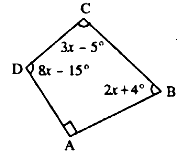
Use the information given in the following figure to find : $(i)\ x\ (ii)\ \angle B$ and $\angle C$
The sides of a triangle are $16\  cm, 12\  cm$, and $20\  cm$. Find : $(i)$ area of the triangle ; $(ii)$ height of the triangle, corresponding to the largest side ; $(iii)$ height of the triangle, corresponding to the smallest side.