Question
Solve graphically that the following system of equation has infinitely many solutions:
$2x + 3y = 6$
$4x + 6y = 12$

Answer

So we have $2x + 3y = 6$ and $4x + 6y = 12.$
Now, $2x + 3y = 5$
$\text{x}=\frac{6-3\text{y}}{2}$
When $y = 0$ then,$ x = 3$ when $y = 2$ then, $x = 0$
$x$
$0$
$3$
$y$
$2$
$0$
Now, 4x + 6y = 12
$\text{x}=\frac{12-6\text{y}}{4}$
When $y = 0$, then $x = 3$ When $y = 2$, then $x = 0$
Thus, we have the following table giving points on the line $4x + 6y = 12$​​​​​​​
$x$
$0$
$3$
$y$
$2$
$0$
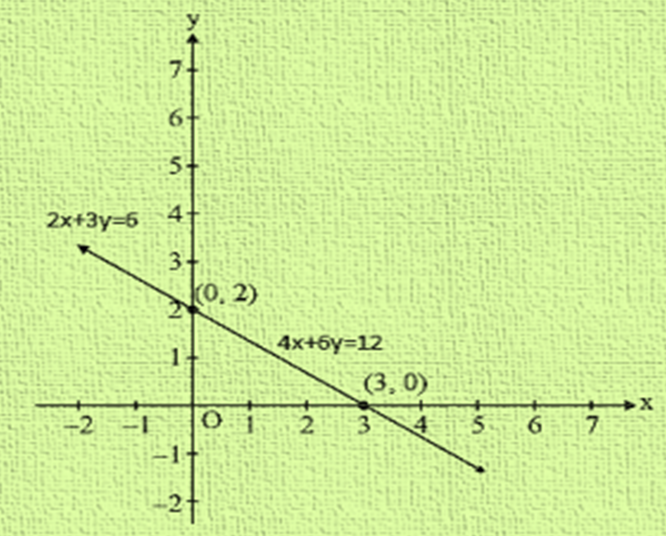
Graph of the equation $2x + 3y = 6$ and $4x + 6y = 12$​​​​​​​

Thus the graphs of the two equations are coincident. Hence, the system of equations has infinitely many solutions.

Need a full question paper?

Generate a complete, print-ready paper with questions like this in minutes — across 16+ boards, with answer keys.
Start Generating Free

Similar questions

Solve the following systems of equations:
$\frac{\text{x}}{2}+\text{y}=0.8,$
$\frac{7}{\text{x}+\frac{\text{y}}{2}}=10.$
Prove the following trigonometric identities.
Given that: $(1+\cos\alpha)(1+\cos\beta)(1+\cos\gamma)=(1-\cos\alpha)(1-\cos\alpha)(1-\cos\beta)(1-\cos\gamma)$
Show that one of the values of each member of this equality is $\sin\alpha\sin\beta\sin\gamma.$
The present age of a father is three years more than three times the age of the son. Three years hence father's age will be $10$ years more than twice the age of the son. Determine their present ages.
In a class test, the sum of Kamal's marks in Mathematics and English is $40$. Had he got $3$ marks more in Mathematics and $4$ marks less in English, the product of the marks would have been $360$. Find his marks in two subjects separately.
Evaluate the following:
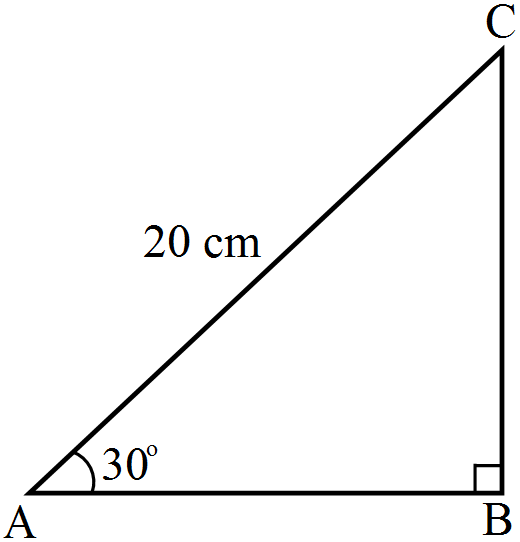
In the adjoining figure, $\triangle\text{ABC}$ is a right-angled triangle in which $\angle\text{B}=90^\circ,\angle\text{A}=30^\circ$ and $AC = 20\ cm.$
Find:
  1. $BC$
  2. $AB.$
In $\triangle\text{ABC},\ \angle\text{ABC}=135^\circ.$ Prove that $AC^2= AB^2+ BC^2+ 4 \text{ar}(\triangle\text{ABC}).$
Prove that both the roots of the equation $(x - a)(x - b) + (x - b)(x - c) + (x - c)(x - a) = 0$ are real but they are equal only when $a = b = c.$
Using the distance formula, show taht the given points are collinear:
$(-1, -1), (2, 3)$ and $(8, 11)$
Solve for $x$ and $y$:
$\frac{1}{\text{2x}}+\frac{1}{\text{3y}}=2,$
$\frac{1}{\text{3x}}+\frac{1}{\text{2y}}=\frac{13}{6}$ $(\text{x}\neq0,\ \text{y}\neq0).$
Solve the following systems of equations:
$x - y + z = 4,$
$x + y + z = 2,$
$2x + y - 3z = 0.$