MCQ
Solve $\sin ^{-1}(1-x)-2 \sin ^{-1} x=\frac{\pi}{2},$ then $x$ is equal to
  • A
    $\frac{1}{2}$
  • B
    $0, \frac{1}{2}$
  • C
    $1, \frac{1}{2}$
  • $0$

Answer

Correct option: D.
$0$
d
$\sin ^{-1}(1-x)-2 \sin ^{-1} x=\frac{\pi}{2}$

$\Rightarrow-2 \sin ^{-1} x=\frac{\pi}{2}-\sin ^{-1}(1-x)$

$\Rightarrow-2 \sin ^{-1} x=\cos ^{-1}(1-x)$ $\dots(1)$

Let $\sin ^{-1} x=\theta \Rightarrow \sin \theta=x \Rightarrow \cos \theta=\sqrt{1-x^{2}}$

$\therefore \theta=\cos ^{-1}(\sqrt{1-x^{2}})$

$\therefore \sin ^{-1} x=\cos ^{-1}(\sqrt{1-x^{2}})$

Therefore, from equation $( 1 )$, we have

$-2 \cos ^{-1}(\sqrt{1-x^{2}})=\cos ^{-1}(1-x)$

Let, $x=\sin y .$ Then, we have:

$-2 \cos ^{-1}(\sqrt{1-\sin ^{2} y})=\cos ^{-1}(1-\sin y)$

$\Rightarrow-2 \cos ^{-1}(\cos y)=\cos ^{-1}(1-\sin y)$

$\Rightarrow-2 y=\cos ^{-1}(1-\sin y)$

$\Rightarrow 1-\sin y=\cos (-2 y)=\cos 2 y$

$\Rightarrow 1-\sin y=1-2 \sin ^{2} y$

$\Rightarrow 2 \sin ^{2} y-\sin y=0$

$\Rightarrow \sin y(2 \sin y-1)=0$

$\Rightarrow \sin y=0$ or $\frac{1}{2}$

$\therefore x=0$ OR $x=\frac{1}{2}$

When $x=\frac{1}{2},$ it can be observed that

L.H.S. $=\sin ^{-1}\left(1-\frac{1}{2}\right)-\sin ^{-1} \frac{1}{2}$

$=\sin ^{-1}\left(\frac{1}{2}\right)-2 \sin ^{-1} \frac{1}{2}$

$=-\sin ^{-1} \frac{1}{2}$

$=\frac{\pi}{6} \neq \frac{\pi}{2} \neq R . H . S$

$\therefore x=\frac{1}{2}$ is not a solution of the given equation. Thus, $x=0$

Need a full question paper?

Generate a complete, print-ready paper with questions like this in minutes — across 16+ boards, with answer keys.
Start Generating Free

Similar questions

The solution of the differential equation ${x^2}dy = - 2xydx$ is
If $f(a + b - x) = f(x),$ then $\int_a^b {x\,f(x)\,dx = } $
The function $f(x) = \int\limits_{ - 1}^x {t({e^t} - 1)(t - 1){{(t - 2)}^3}{{(t - 3)}^5}} dt$ has a local minimum at $ x =$ ..........
The minimum value of Z = 4x + 3y subjected to the constraints $3\text{x}+2\text{y}\geq160,$ $5+2\text{y}\geq200,$$ 2\text{y}\geq80;\text{x},\text{y}\geq0$ is:
The value of the integral  $\int\limits_4^{10} {\frac{{\left[ {{x^2}} \right]dx}}{{\left[ {{x^2} - 28x + 196} \right] + \left[ {{x^2}} \right]}}}$ , where $\left[ x \right]$ denotes the greatest integer less than or equal to $x$, is
Function $f\left( x \right) = \left( {x - 2} \right)\left| {x - 3} \right|$ is monotonically increasing in
 
Direction ratios of the normal to the plane passing through the points $(0, 1, 1), (1, 1, 2)$ and $(-1, 2, -2)$ are
$\left| {\,\begin{array}{*{20}{c}}{{{\sin }^2}x}&{{{\cos }^2}x}&1\\{{{\cos }^2}x}&{{{\sin }^2}x}&1\\{ - 10}&{12}&2\end{array}\,} \right| = $
Let $a$ and $\mathrm{b}$ respectively be the points of local maximum and local minimum of the function $f(x)=2 x^{3}-3 x^{2}-12 x .$ If $A$ is the total area of the region bounded by $\mathrm{y}=\mathrm{f}(\mathrm{x})$, the $\mathrm{x}$-axis and the lines $x=a$ and $x=b$, then $4 A$ is equal to ..... .
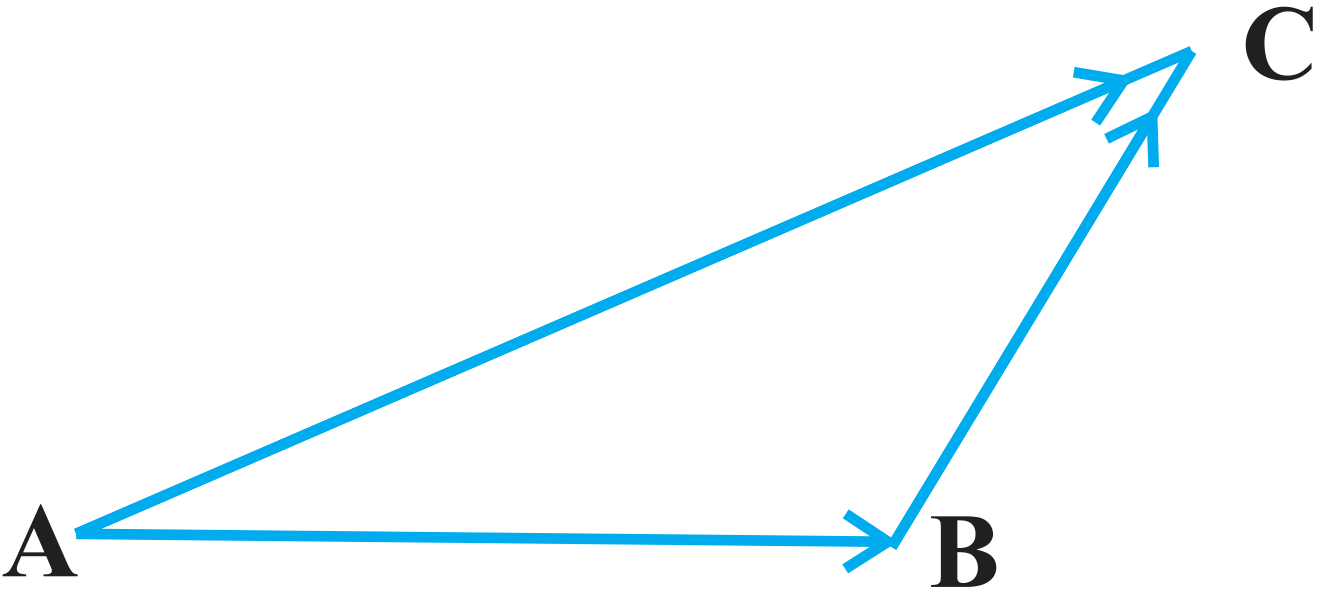
In triangle ABC (Fig 10.18), which of the following is not true:

  1. $\overrightarrow{\text{AB}}+\overrightarrow{\text{BC}}+\overrightarrow{\text{CA}}=\vec{0}$
  2. $\overrightarrow{\text{AB}}+\overrightarrow{\text{BC}}-\overrightarrow{\text{AC}}=\vec{0}$
  3. $\overrightarrow{\text{AB}}+\overrightarrow{\text{BC}}-\overrightarrow{\text{CA}}=\vec{0}$
  4. $\overrightarrow{\text{AB}}-\overrightarrow{\text{CB}}+\overrightarrow{\text{CA}}=\vec{0}$