Question
Solve: $\frac{\text{ax}}{\text{b}}-\frac{\text{by}}{\text{a}}=\text{a}+\text{b},$ $\text{ax}-\text{by}=\text{2ab}.$

Answer

The given equation may be written as follows:
$\frac{\text{ax}}{\text{b}}-\frac{\text{by}}{\text{a}}-(\text{a+b})=0\ ...(\text{i})$
$ax - by - 2ab = 0 ...(ii)$
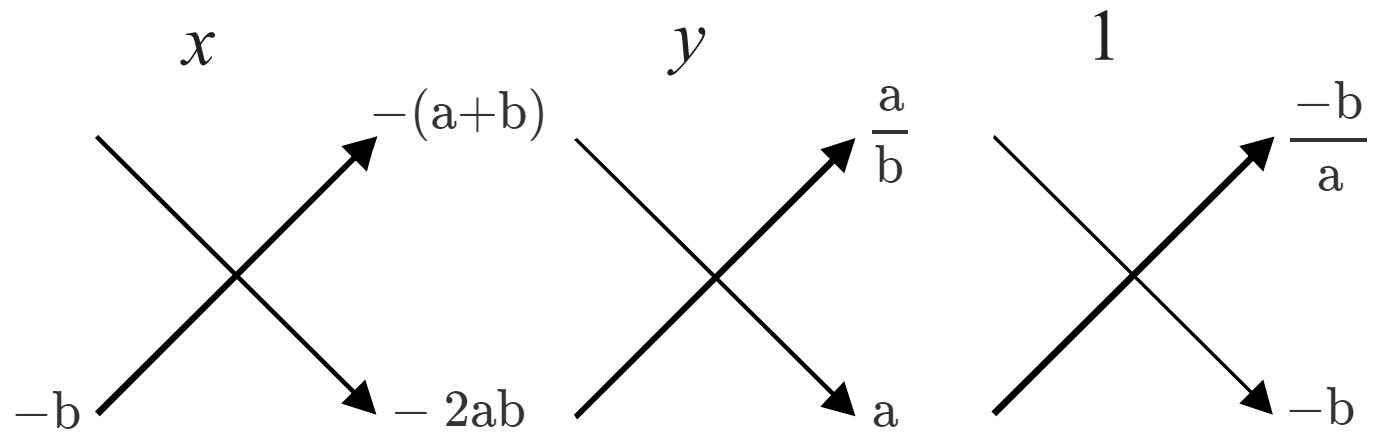
Here, $\text{a}_1=\frac{\text{a}}{\text{b}},\ \text{b}_1=\frac{\text{b}_1}{\text{a}},$ $\text{c}_1=-(\text{a+b}),\ \text{a}_2=\text{a},$ $\text{b}_2= -\text{b},\ \text{c}_2=-2\text{ab}$
By cross multiplying, we have:

$\therefore\frac{\text{x}}{\big(-\frac{\text{b}}{\text{a}}\big)\times(-2\text{ab})-(-\text{b})\times(-(\text{a+b}))}\\\ \ \ =\frac{\text{y}}{-(\text{a+b})\times\text{a}-(-2\text{ab})\times\frac{\text{a}}{\text{b}}}\\\ \ \ =\frac{1}{\frac{\text{a}}{\text{b}}\times(-\text{b})-\text{a}\times\big(-\frac{\text{b}}{\text{a}}\big)}$
$\Rightarrow\frac{\text{x}}{2\text{b}^2-\text{b}(\text{a+b})}=\frac{\text{y}}{-(\text{a+b})+2\text{a}^2}=\frac{1}{-\text{a+b}}$
$\Rightarrow\frac{\text{x}}{2\text{b}^2-\text{ab}-\text{b}^2}=\frac{\text{y}}{-\text{a}^2-\text{ab}+2\text{a}^2}=\frac{1}{-\text{a+b}}$
$\Rightarrow\frac{\text{x}}{\text{b}^2-\text{ab}}=\frac{\text{y}}{\text{a}^2-\text{ab}}=\frac{1}{-(\text{a}-\text{b})}$
$\Rightarrow\frac{\text{x}}{-\text{b}(-\text{a}-\text{b})}=\frac{\text{y}}{\text{a}(\text{a}-\text{b})}=\frac{1}{-(\text{a}-\text{b})}$
$\Rightarrow\text{x}=\frac{-\text{b}(\text{a}-\text{b})}{-(\text{a}-\text{b})}=\text{b},\ \text{y}=\frac{\text{a}(\text{a}-\text{b})}{-(\text{a}-\text{b})}=-\text{a}$
Hence, $x = b$ and $y = -a$ is the required solution.

Need a full question paper?

Generate a complete, print-ready paper with questions like this in minutes — across 16+ boards, with answer keys.
Start Generating Free

Similar questions

Determine, graphically, the vertices of the triangles formed by the lines $y = x, 3y = x, x + y = 8.$
The area of a rectangle remains the same if the length is increased by $7$ meters and the breadth is decreased by $3$ meters. The area remains unaffected if the length is decreased by $7$ meters and breadth in increased by $5$ meters. Find the dimensions of the rectangle.
If $\alpha$ and $\beta$ are the zeros of the quadratic polynomial $\text{f(x)}=\text{x}^2-\text{px}-+2$, prove that $\frac{\alpha^2}{\beta^2}+\frac{\beta^2}{\alpha^2}=\frac{\text{p}^2}{\text{q}}-\frac{4\text{p}^2}{\text{q}}+2.$
If the sum of first $p$ term of an AP is $(ap^2+ bp),$ find its common difference.
The first term of an $AP$ is $p$ and its common difference is $q$. Find its $10^{th}$ term.
A metallic solid right circular cone is of height $84\ cm$ and the radius of its base is $21\ cm$. It is melted and recast into a solid sphere. Find the diameter of the sphere.
A box contains cards bearing numbers $6$ to $70.$ If one card is drawn at random from the box, find the probability that it bears:
  1. A one$-$digit number.
  2. A number divisible by $5.$
  3. An odd number less than $30.$
  4. A composite number between $50$ and $70.$
The sum of the squares of two consecutive positive integers is $365$. Find the integers.
Evaluate the following:
If $\sin(\text{A}+\text{B})=1$ and $\cos(\text{A}-\text{B})=1,0^\circ\leq(\text{A}+\text{B})\leq90^\circ$ and $\text{A}>\text{B}$ then find $A$ and $B.$
If the roots of the equation $\left(a^2+b^2\right) x^2-2(a c+b d) x+\left(c^2+d^2\right)=0$ are equal prove that $\frac{\text{a}}{\text{b}}=\frac{\text{c}}{\text{d}}.$