Question
Solve the following differential equation
$\frac{\text{dy}}{\text{dx}}=\frac{1-\cos2\text{y}}{1+\cos2\text{y}}$

Answer

We have
$\frac{\text{dy}}{\text{dx}}=\frac{1-\cos2\text{y}}{1+\cos2\text{y}}$
$=\frac{2\sin^2\text{y}}{2\cos^2\text{y}}$
$\frac{\text{dy}}{\text{dx}}=\tan^2\text{y}$
$\frac{\text{dy}}{\tan^2\text{y}}=\text{dx}$
$\int\cot^2\text{y dy}=\int\text{dx}$
$\int(\text{cosec}^2\text{y}-1)\text{dy}=\int\text{dx}$
$-\cot\text{y}-\text{y}+\text{C}=\text{x}$
$\text{C}=\text{x}+\text{y}+\cot\text{y}$

Need a full question paper?

Generate a complete, print-ready paper with questions like this in minutes — across 16+ boards, with answer keys.
Start Generating Free

Similar questions

Suppose that 5% of men and 0.25% of women have grey hair. A grey haired person is selected at random. What is the probability of this person being male? Assume that there are equal number of males and females.
Find the points o local maxima or local minima, if any, of the following functions, using the first derivatives test. Also, find the local maximum or local minimum values, as the case may be:
$\text{f}(\text{x})=\text{x}\sqrt{1-\text{x}}, \text{x}\geq0$ 
$\text{Show that}\int^{\text{a}}\limits_{0}\text{f}\text{(x)}\text{g}\text{(x)}\text{dx}=2\int^{\text{a}}\limits_{0}\text{f}\text{(x)}\text{dx}\text,$if and are defined as $\text{f(x)}=\text{f(a}-\text{x)}$ and $\text{g(x)}+\text{g(a}-\text{x)}=4$ 
Solve the following differential equation
$\frac{\text{dy}}{\text{dx}}=\text{x}^5+\text{x}^2-\frac{2}{\text{x}},\text{x}\ne0$
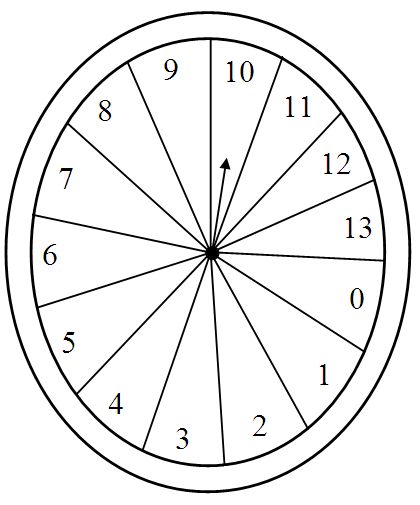
In roulette, Figure, the wheel has 13 numbers 0, 1, 2,...., 12 maked on equally spaced slots. A player sets Rs 10 on a given number. He recieves Rs 100 from the organiser of the game if the ball comes to rest in this slot; otherwise he gets nothing. If X denotes the players net gain/loss, Find E(X).

Show that $\text{AB}\neq\text{BA}$ in the following cases:
$\text{A}=\begin{bmatrix}5&-1\\6&7\end{bmatrix}$ and $\text{B}=\begin{bmatrix}2&1\\3&4\end{bmatrix}$
$A = R -\{3\}, B = R -\{1\}$ consider the function $f: A \rightarrow B$ defined by $f(x)=\frac{x-2}{x-3}$. Is $f$ bijective? If yes then find Inverse function of $f$.
Integrate the function in Exercise:

$\tan^{-1}\sqrt{\frac{1-\text{x}}{1+\text{x}}}$

If a machine is correctly set up it produces 90% acceptable items. If it is incorrectly set up it produces only 40% acceptable item. Past experience shows that 80% of the setups are correctly done. If after a certain set up, the machine produces 2 acceptable items, find the probability that the machine is correctly set up.
A girl walks 4 km towards west, then she walks 3 km in a direction 30° east of north and stops. Determine the girl’s displacement from her initial point of departure.