Question
Solve the following differential equation:
$\frac{\text{dy}}{\text{dx}}+2\text{y}=\text{xe}^{4\text{x}}$

Answer

We have, $\frac{\text{dy}}{\text{dx}}+2\text{y}=\text{xe}^{4\text{x}}\ \dots(1)$ Clearly, it is a linear differential equation of the form $\frac{\text{dy}}{\text{dx}}+\text{Py}=\text{Q}$ where $\text{P}=2$
$\text{Q}=\text{xe}^{4\text{x}}$
$\therefore$ I.F. $=\text{e}^{\int\text{Pdx}}$
$=\text{e}^{\int2\text{dx}}$
$=\text{e}^{2\text{x}}$Multiplying both sides of (1) by $e^{2x}$, we get
$\text{e}^{2\text{x}}\Big(\frac{\text{dy}}{\text{dx}}+2\text{y}\Big)=\text{e}^{2\text{x}}\times\text{xe}^{4\text{x}}$$\Rightarrow\ \text{e}^{2\text{x}}\frac{\text{dy}}{\text{dx}}+2\text{e}^{2\text{x}}\text{y}=\text{xe}^{6\text{x}}$
Integrating both sides with respect to x, we get
$\text{e}^{2\text{x}}\text{y}=\int\text{e}^{6\text{x}}\text{xdx + C}$
$\Rightarrow\ \text{e}^{2\text{x}}\text{y}=\text{x}\int\text{e}^{6\text{x}}\text{dx}-\int\Big[\frac{\text{d}}{\text{dx}}(\text{x})\int\text{e}^{6\text{x}}\text{dx}\Big]\text{dx + C}$$\Rightarrow\ \text{e}^{2\text{x}}\text{y}=\frac{\text{x}\text{e}^{6\text{x}}}{6}-\frac{\text{e}^{6\text{x}}}{36}+\text{C}$
$\Rightarrow\ \text{y}=\frac{\text{xe}^{4\text{x}}}{6}-\frac{\text{e}^{4\text{x}}}{36}+\text{Ce}^{-2\text{x}}$ Hence, $\text{y}=\frac{\text{xe}^{4\text{x}}}{6}-\frac{\text{e}^{4\text{x}}}{36}+\text{Ce}^{-2\text{x}}$ is the required solution.

Need a full question paper?

Generate a complete, print-ready paper with questions like this in minutes — across 16+ boards, with answer keys.
Start Generating Free

Similar questions

Show that the following curves intersect orthogonally at the indicated points:
$y^2 = 8x $and $2x^2 + y^2 = 10 $at $\big(1,2\sqrt{2})$
Find $\frac{\text{dy}}{\text{dx}}$
$\text{y}=\text{x}^{\sin\text{x}}+\big(\sin\text{x}\big)^\text{x}$
Find the points of local maxima or local minima and corresponding local maximum and local minimum values of the following functions. Also, find the points of inflection,
$\text{f}(\text{x})=\text{x}\sqrt{32-\text{x}^{2}}, -5\leq\text{x}\leq5$
Find the feasible solution of the following inequations graphically : 3x + 2y ≤ 18, 2x + y ≤ 10, x ≥ 0, y ≥ 0
If a body cools from 80°C to 50°C at room temperature of 25°C in 30 minutes, find the temperature of the body after 1 hour.
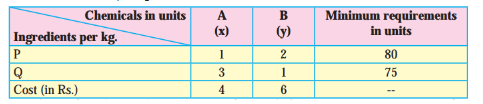
A factory produced two types of chemicals A and B. The following table gives the units of ingredients P and Q (per kg) of chemicals A and B as well as minimum requirements of P and Q and also cost per kg. chemicals A and B :

Image

Find the number of units of chemicals A and B should be produced so as to minimize the cost.

Find the maximum and the minimum values, if any, without using derivaives of the following functions:f(x) = |sin4x + 3| on R.
The strength of a beam varies as the product of its breadth and square of its depth. Find the dimensions of the strongest beam which can be cut from a circular log of radius a.
Solve the following differential equation:
$(1+\text{x}^2)\frac{\text{dy}}{\text{dx}}+\text{y}=\tan^{-1}\text{x}$
Prove the following identities:
$\begin{vmatrix}\text{a}+\text{x}&\text{y}&\text{z}\\\text{x}&\text{a}+\text{y}&\text{z}\\\text{x}&\text{y}&\text{a}+\text{z}\end{vmatrix}=\text{a}^2(\text{a}+\text{x}+\text{y}+\text{z})$