Question
Solve the following differential equations:
$\frac{\text{dy}}{\text{dx}}=2\text{xy, y}(0)=1$

Answer

$\frac{\text{dy}}{\text{dx}}=2\text{xy, y}(0)=1$
$\int\frac{\text{dy}}{\text{y}}=\int2\text{x dx}$
$\log|\text{y}|=2\frac{\text{x}^2}{2}+\text{C}$
$\log|\text{y}|=\text{x}^2+\text{C}...(1)$
Put $\text{x}=0,\text{y}=1$
$\log(1)=0+\text{C}$
$0=0+\text{C}$
$\text{C}=0$
Put $\text{C}=0$ in equation (1),
$\log\text{y = x}^2$
$\text{y = e}^{\text{x}^{2}}$

Need a full question paper?

Generate a complete, print-ready paper with questions like this in minutes — across 16+ boards, with answer keys.
Start Generating Free

Similar questions

Three relation R1 is defined in set A = {a, b, c} as follows:
R1 = {(a, a), (a, b), (a, c), (b, b), (b, c), (c, a), (c, b), (c, c)}
Find whether or not the relation Ron A is:
  1. Reflexive.
  2. Symmetric.
  3. Transitive.
Write the normal form of the equation of the plane 2x - 3y + 6z + 14 = 0
If $\text{y}=\sqrt{\tan\text{x}+\sqrt{\tan\text{x}+\sqrt{\tan\text{x}+\ .... \text{to }\infty}}}$ prove that $\frac{\text{dy}}{\text{dx}}=\frac{\sec^2\text{x}}{2\text{y}-1}$
Ten eggs are drawn successively, with replacement, from a lot containing 10% defective eggs. Find the probability that there is at least one defective egg.
If A = {1, 2, 3, 4} define relations on A which have properties of being:
Reflexive, transitive but not symmetric.
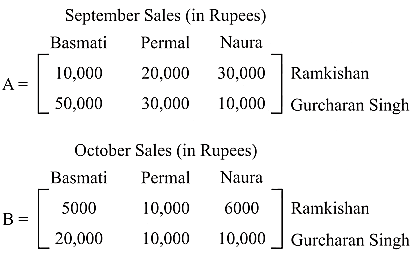
Two farmers Ramkishan and Gurcharan Singh cultivates only three varieties of rice namely Basmati, Permal and Naura. The sale (in Rupees) of these varieties of rice by both the farmers in the month of September and October are given by the following matrices A and B.

  1. Find the combined sales in September and October for each farmer in each variety.
  2. Find the decrease in sales from September to October.
  3. If both farmers receive 2% profit on gross sales, compute the profit for each farmer and for each variety sold in October.
Give examples of two one-one functions f1 and f2 from R to R, such that f1 + f2 : R → R. defined by (f1 + f2)(x) = f1(x) + f2(x) is not one-one.
Differentiate $\sqrt{\frac{(x-3)\left(x^{2}+4\right)}{3 x^{2}+4 x+5}}$ w.r.t. x.
Differentiate the following functions with respect to x:
$\sin^2(2\text{x}+1)$
A box contains 13 bulbs, out of which 5 are defective. 3 bulbs are randomly drawn, one by one without replacement, from the box. Find the probability distribution of the number of defective bulbs.