Question
Solve the following differential equations:
$\frac{\text{dy}}{\text{dx}}=2\text{e}^{\text{x}}\text{y}^3,\text{y}(0)=\frac{1}{2}$

Answer

We have,
$\frac{\text{dy}}{\text{dx}}=2\text{e}^{\text{x}}\text{y}^3,\text{y}(0)=\frac{1}{2}$
$\Rightarrow\frac{1}{\text{y}^3}\text{dy}=2\text{e}^{\text{x}}\text{dx}$
Integrating both sides, we get
$\int\frac{1}{\text{y}^3}\text{dy}=\int2\text{e}^{\text{x}}\text{dx}$
$\Rightarrow-\frac{1}{2\text{y}^3}=2\text{e}^{\text{x}}+\text{C}...(1)$
Given: at $\text{x}=0,\text{y}=\frac{1}{2}$
Substituting the valuse of x and y in (1), we get
$-\frac{1}{2\times\frac{1}{4}}=2\text{e}^{0}+\text{C}$
$\Rightarrow\text{C}=-2-2$
$\Rightarrow\text{C}=-4$
Substituting the value of C in (1), we get
$\Rightarrow-\frac{1}{2\text{y}^2}=2\text{e}^{\text{x}}-4$
$\Rightarrow\text{y}^{2}(8-4\text{e}^{\text{x}})=1$
Hence, $\text{y}^{\text{x}}(8-4\text{e}^{\text{x}})=1$ is the required solution.

Need a full question paper?

Generate a complete, print-ready paper with questions like this in minutes — across 16+ boards, with answer keys.
Start Generating Free

Similar questions

A farmer mixes two brands P and Q of cattle feed. Brand P, costing Rs. 250 per bag, contains 3 units of nutritional element A, 2.5 units of element B and 2 units of element C. Brand Q costing Rs. 200 per bag contains 1.5 units of nutritional element A, 11.25 units of element B, and 3 units of element C. The minimum of nutrients A, B and C are 18 units, 45 units and 24 units respectively. Determine the number of bags of each brand which should be mixed in order to produce a mixture having a minimum cost per bag? What is the minimum cost of the mixture per bag?
Find the vector equation of the plane passing through the points P(2, 5, -3), Q(-2, -3, 5) and R(5, 3, -3).
The x-intercept of the tangent line to a curve is equal to the ordinate of the point of contact. Find the particular curve through the point (1, 1).
Evaluate the following integrals:
$\int\frac{\text{x}^2+1}{\text{x}^2+7\text{x}^2+1}\ \text{dx}$
If $\text{y}=\text{x}\sin(\text{a}+\text{y}),$ prove that $\frac{\text{dx}}{\text{dx}}=\frac{\sin^2(\text{a}+\text{y})}{\sin(\text{a}+\text{y})-\text{y}\cos(\text{a}+\text{y})}$
If $\big|\vec{\text{a}}+\vec{\text{b}}\big|=60,\big|\vec{\text{a}}-\vec{\text{b}}\big|=40$ and $\big|\vec{\text{b}}\big|=46,$ find $|\vec{\text{a}}|$
Find the equation of a curve passing through the point (0, 2) given that the sum of the coordinates of any point on the curve exceeds the magnitude of the slope of the tangent to the curve at that point by 5.
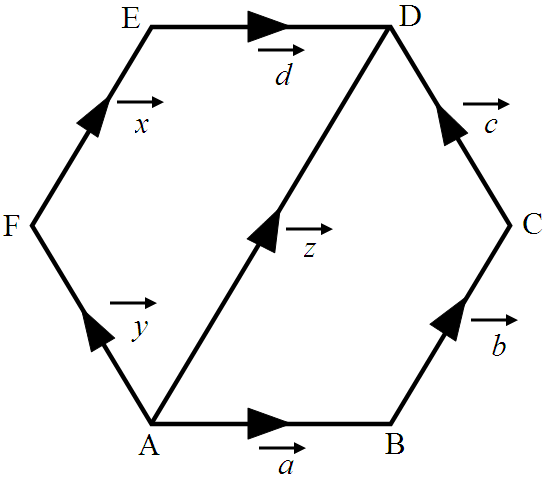
In Figure ABCD is a regular hexagon, which vectors are:
  1. Collinear.
  2. Equal.
  3. Co-initial.
  4. Collinear but not equal.
Find the equation of the curve satisfying $\text{x}(\text{x}+1)\frac{\text{dy}}{\text{dx}}-\text{y}=\text{x}(\text{x}+1)$ and passing through (1, 0).
Evaluate the following integrals:$\int\frac{\text{x}-3}{\text{x}^2+2\text{x}-4}\text{ dx}$