Question
Solve the following equation by factorization $\frac{x+1}{x-1}+\frac{x-2}{x+2}=3$

Answer

$
\begin{aligned}
& \frac{x+1}{x-1}+\frac{x-2}{x+2}=3 \\
& \Rightarrow \frac{(x+1)(x+2)+(x-2)(x-1)}{(x-1)(x+2)}=3 \\
& \Rightarrow \frac{x^2+2 x+x+2+x^2-x-2 x+2}{x^2+2 x-x-2} \\
& \Rightarrow \frac{x^2+3 x+2+x^2-3 x+2}{x^2+x-2}=\frac{3}{1} \\
& \Rightarrow 2 x^2+4=3 x^2+3 x-6 \\
& \Rightarrow 2 x^2+4-3 x^2-3 x+6=0 \\
& \Rightarrow-x^2-3 x+10=0 \\
& \Rightarrow x^2+3 x-10=0 \\
& \Rightarrow x^2+5 x-2 x-10=0 \\
& \Rightarrow x(x+5)-2(x+5)=0 \\
& \Rightarrow(x+5)(x-2)=0
\end{aligned}
$
Either $x+5=0$,
then $x=-5$
or
$
x-2=0 \text {, }
$
then $x =2$
Hence $x=-5,2$.

Need a full question paper?

Generate a complete, print-ready paper with questions like this in minutes — across 16+ boards, with answer keys.
Start Generating Free

Similar questions

In an auditorium, seats were arranged in rows and columns. The number of rows was equal to the number of seats in each row. When the number of rows was doubled and the number of seats in each row was reduced by $10,$ the total number of seats increased by $300.$ Find:
(1) the number of rows in the original arrangement.
(2) the number of seats in the auditorium after re-arrangement.
A man invests Rs 1,680 in buying shares of nominal value ₹ 24 and selling at 12% premium. The dividend on the shares is 15% per annum. Calculate:
1) the number of shares he buys;
2) the dividend he receives annually.
For what value of $n$, are the $n$th terms of two AP's $63,65,67$, $\ldots\ldots$ and $3,10,17$, $\ldots\ldots$ equal?
A person invests Rs. 4368 and buys certain hundred-rupee shares at 91. He sells out shares worth Rs. 2400 when they have t risen to 95 and the remainder when they have fallen to 85. Find the gain or loss on the total transaction,
Reema deposited ₹ $ 200$ per month for 3 years in a bank's recurring deposit account. If the bank pays interest at the rate of $11 \%$ p.a., find the amount she gets on maturity.
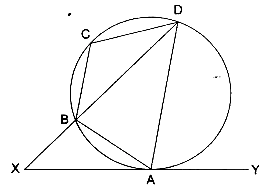
In the joining figure shown XAY is a tangent. If ∠ BDA = 44°, ∠ BXA = 36°.
Calculate: (i) ∠ BAX, (ii) ∠ DAY, (iii) ∠ DAB, (iv) ∠ BCD.
Prove.
$(\cot A-\operatorname{cosec} A)^2=\frac{1-\cos A}{1+\cos A}$
A person bought 360 ten - rupee shares paying $12 \%$ dividend at par and sold them at ₹ $ 21$. The proceeds were invested in five - rupee shares paying $4 \frac{1}{2} \%$ at ₹ $ 3.5$ per share. Find (i) sale proceeds (ii) the number of five - rupee shares bought (iii) the percentage increase in income.
Find the reciprocal ratio of e following :
$81pq^2 : 54p^2q$
the line $x – 6y + 11 = 0$ bisects the join of $(8, −1)$ and $(0, k).$ Find the value of $k.$