Question
Solve the following equation:
$\sin^{2}\text{x}-\cos\text{x}=\frac{1}{4}$

Answer

We have,
$\sin^{2}\text{x}-\cos\text{x}=\frac{1}{4}$
$\Rightarrow1-\cos^{2}\text{x}-\cos\text{x}=\frac{1}{4}$ $[\because\sin^{2}\text{x}=1-\cos^{2}\text{x}]$
$\Rightarrow\cos^{2}\text{x}+\cos\text{x}-\frac{3}{4}=0$
$\Rightarrow4\cos^{2}\text{x}+4\cos\text{x}-3=0$
$\Rightarrow4\cos^{2}\text{x}+6\cos\text{x}+2\cos\text{x}-3=0$ [factorize it]
$\Rightarrow2\cos\text{x}(2\cos\text{x}+3)-1(\cos\text{x}+3)=0$
$\Rightarrow(2\cos\text{x}-1)(2\cos\text{x}+3)=0$
$\Rightarrow\text{ Either}$
$2\cos\text{x}-1=0$ or $2\cos\text{x}+3=0$
$\Rightarrow\cos\text{x}=\frac{1}{2}$ or $\cos\text{x}=-\frac{3}{2}$ [This is not possible as $-1<\cos\text{x}<1$]
$\Rightarrow\cos\text{x}=\cos\frac{\pi}{3}$
$\Rightarrow\text{x}=2\text{n}\pi\pm\frac{\pi}{3},\text{n}\in\text{z}$

Need a full question paper?

Generate a complete, print-ready paper with questions like this in minutes — across 16+ boards, with answer keys.
Start Generating Free

Similar questions

Prove that:
$\frac{\sin\text{A}\sin2\text{A}+\sin3\text{A}\sin6\text{A}}{\sin\text{A}\cos2\text{A}+\sin3\text{A}\cos6\text{A}}=\tan5\text{A}$
A man arranges to pay off a debt of ₹ 3600 by 40 annual instalments which form an arithmetic series. When 30 of the instalments are paid, he dies leaving one-third of the debt unpaid, find the value of the first instalment.
If $\text{x}^{\text{a}}=\text{x}^{\frac{\text{b}}{2}}\text{z}^{\frac{\text{b}}{2}}=\text{z}^{\text{c}},$ then prove that $\frac{1}{\text{a}},\frac{1}{\text{b}},\frac{1}{\text{c}}$ are in A.P.
If $\text{a}\cos2\theta+\text{b}\sin2\theta=\text{c}$ has $\alpha$ and $\beta$ as its roots, then prove that $\tan\alpha+\tan\beta=\frac{2\text{b}}{\text{a+b}}.$
[Hint: Use the identities $\cos2\theta=\frac{1-\tan^2\theta}{1+\tan^2\theta}$ and $\sin2\theta=\frac{2\tan\theta}{1+\tan^2\theta}\Big].$
If $\sin\text{x}+\cos\text{x}=0$ and x lies in the fourth quadrant, find $\sin \text{x } $and $\cos\text{x}.$
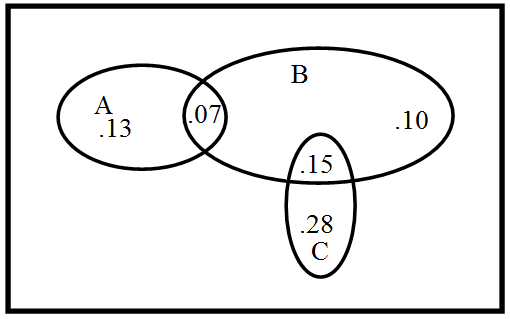
The accompanying Venn diagram shows three events, A, B, and C, and also the probabilities of the various intersections $($for instance, $\text{P}(\text{A}\cap\text{B})=.07)$ Determine:
  1. $\text{P(A)}$
  2. $\text{P}(\text{B}\cap\bar{\text{C}})$
  3. $\text{P(A}\cup\text{B})$
  4. $\text{P(A}\cap\bar{\text{B}})$
  5. $\text{P(B}\cap\text{C})$
  6. Probability of exactly one of the three occurs.
If $\text{x}=\sec\phi-\tan\phi$ and $\text{y}=\text{cosec}\phi+\cot\phi$ then show that $\text{xy}+\text{x}-\text{y}+1=0$
[Hint: Find xy + 1 and then show that x - y = -(xy + 1)]
Prove that $1+\frac{1}{4}+\frac{1}{9}+\frac{1}{16}+...+\frac{1}{\text{n}^2}<2-\frac{1}{\text{n}}$ for all $\text{n}>2,$ $\text{n}\in\text{N}.$
If the lines 3x - 4y + 4 = 0 and 6x - 8y - 7 = 0 are tangents to a circle, then find the radius of the circle.
A manufacturer of radio sets produced 600 units in the third year and 700 units in the seventh year. Assuming that the product increases uniformly by a fixed number every year, find:
  1. The production in the first year.
  2. The total product in 7 years and
  3. The product in the 10th year.