Question
Solve the following equations by Cramer’s method.
6x – 3y = –10; 3x + 5y – 8 = 0

Answer


$\begin{aligned} & 6 x-3 y=-10 \\ & 3 x+5 y=8 \\ & D=\left[\begin{array}{cc}6 & -3 \\ 3 & 5\end{array}\right]=(6 \times 5)-(-3 \times 3)=30+9=39 \\ & D_x=\left[\begin{array}{cc}-10 & -3 \\ 8 & 5\end{array}\right]=(-10 \times 5)-3 \times 8=-50+24=-26 \\ & D_y=\left[\begin{array}{cc}6 & -10 \\ 3 & 8\end{array}\right]=(6 \times 8)-(-10 \times 3)=48+30=78 \\ & x=\frac{D_x}{D}=\frac{-26}{39}=\frac{-2}{3} y=\frac{D_y}{D}=\frac{78}{39}=2 \\ & \therefore(x, y)=\left(-\frac{2}{3}, 2\right)\end{aligned}$

Need a full question paper?

Generate a complete, print-ready paper with questions like this in minutes — across 16+ boards, with answer keys.
Start Generating Free

Similar questions

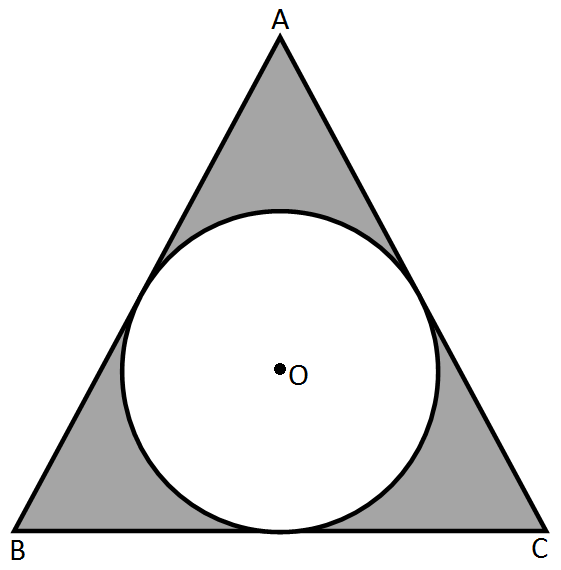
A circle is inscribed in an equilateral triangle ABC is side 12cm, touching its sides (the following figure). Find the radius of the inscribed circle and the area of the shaded part.
The eighth term of an A.P. is half of its second term and the eleventh term exceeds one third of its fourth term by $1$. Find the $15^{th}$​​​​​​​ term.
In the following, one of the six trigonometric ratios is given. Find the values of the other trigonometric ratios.
$\text{cosec }\theta=\sqrt{10}$
Solve the following quadratic equations by factorization:
$\frac{1}{\text{x}-1}-\frac{1}{\text{x}+5}=\frac{6}{7},$ $\text{x}\neq1,-5$
A hollow sphere of internal and external radii $2\ cm$ and $4cm$ respectively is melted into a cone of base radius $4\ cm$. Find the height and slant height of the cone.
If $\alpha$ and $\beta$ are the roots of equation $x^2-4 x+1=0$, find
$\alpha^3+\beta^3$
Which value(s) of $\lambda,$ do the pair of linear equations $\lambda\text{x}+\text{y}=\lambda^2$ and $\text{x}+\lambda\text{y}=1$ have:
No solution?
A well of diameter 3m is dug 14m deep. The earth taken out of it is spread evenly all around it to a width of 4m to form an embankment. Find the height of the embankment.
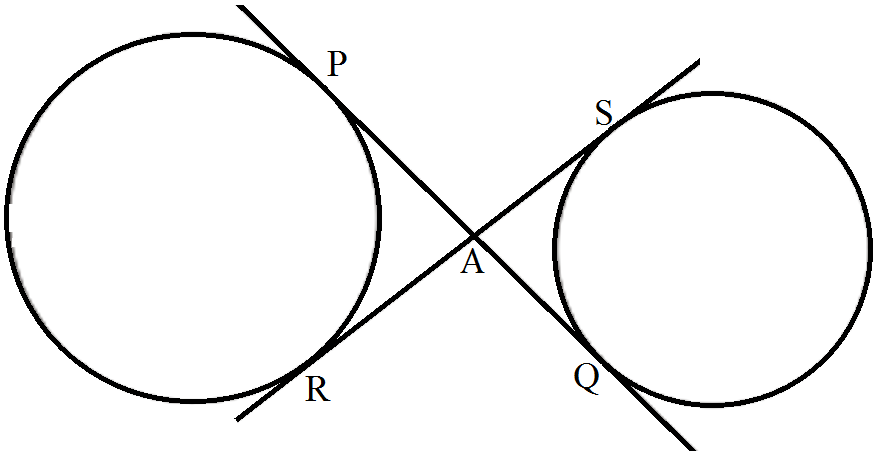
In the given figure, common tangents PQ and RS to two circles intersect at A. Prove that PQ = RS.
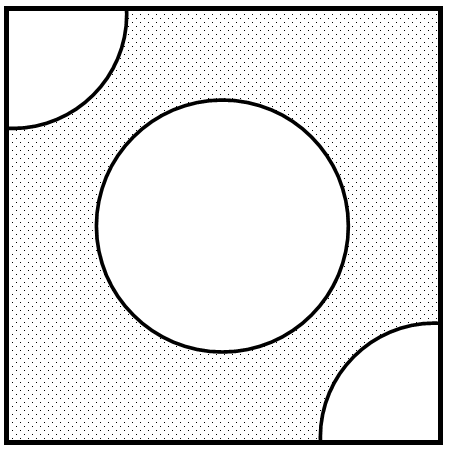
From each of the two opposite corners of a square of side $8\ cm$, a quadrant of a circle of radius $1.4\ cm$ is cut. Another circle of radius $4.2\ cm$ is also cut from the centre as shown in the following figure. Find the area of the remaining (Shaded) portion of the square.$\Big(\text{Use }\pi=\frac{22}{7}\Big)$