Question
Solve the following equations by Cramer’s method.
6x – 3y = –10; 3x + 5y – 8 = 0

Answer

$6x-3y = -10$
$3 x+5 y=8 $
$D=\left[\begin{array}{cc}6 & -3 \\ 3 & 5\end{array}\right]=(6 \times 5)-(-3 \times 3)=30+9=39$
$ D_x=\left[\begin{array}{cc}-10 & -3 \\ 8 & 5\end{array}\right]=(-10 \times 5)-3 \times 8=-50+24=-26 $
$ D_y=\left[\begin{array}{cc}6 & -10 \\ 3 & 8\end{array}\right]=(6 \times 8)-(-10 \times 3)=48+30=78$
$ x=\frac{D_x}{D}=\frac{-26}{39}=\frac{-2}{3} y=\frac{D_y}{D}=\frac{78}{39}=2 $
$ \therefore(x, y)=\left(-\frac{2}{3}, 2\right)$

Need a full question paper?

Generate a complete, print-ready paper with questions like this in minutes — across 16+ boards, with answer keys.
Start Generating Free

Similar questions

The product of Shikha's age five years ago and her age $8$ years later is $30$, her age at both times being given in years. Find her present age.
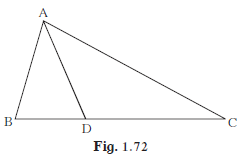
In Δ ABC, B - D – C and BD = 7, BC = 20 then find following ratios.

$(1)\frac{ A (\Delta ABD )}{ A (\Delta ADC )}$
$(2)\frac{ A (\Delta ABD )}{ A (\Delta ABC )}$
$(3)\frac{ A (\Delta ADC )}{ A (\Delta ABC )}$
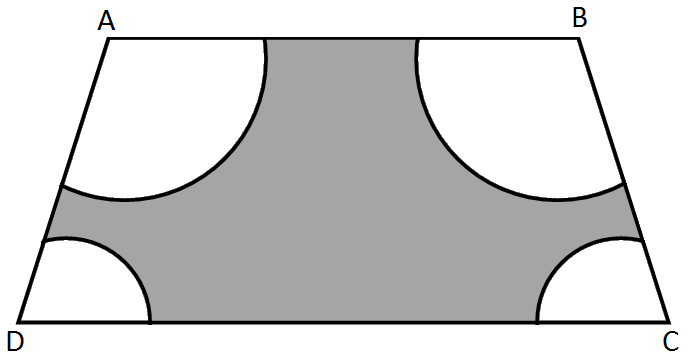
In the given figure, ABCD is a trapezium with $\text{AB}||\text{DC},\text{AB}=18\text{cm}$ DC = 32cm and the distance between AB and DC is 14cm. Circles of equal radii 7cm with centres A, B, C and D have been drawn. Then find the area of the shaded region.$\Big(\text{Use }\pi=\frac{22}{7}\Big)$
Show that any positive odd integer is of the form (6m + 1) or (6m + 3) or (6m + 5), where m is some integer.
$\triangle \mathrm{ABC} \sim \triangle \mathrm{PQR}$, in $\triangle \mathrm{ABC}, \mathrm{AB}=5.4 \mathrm{~cm}, \mathrm{BC}=4.2 \mathrm{~cm}, \mathrm{AC}=6.0 \mathrm{~cm}$.
$\mathrm{AB}: \mathrm{PQ}=3: 2$. Construct $\triangle \mathrm{ABC}$ and $\triangle \mathrm{PQR}$.
If the roots of the equation $(c^2 - ab)x^2 - 2(a^2 - bc)x + (b^2 - ac) = 0$ are real and equal, show that either $a = 0 or (a^3 + b^3 + c^3) = 3abc$.
In an isosceles triangle $ABC, AB = AC = 25\ cm$, $BC = 14\ cm$, Calculate the altitude from $A$ on $BC$.
Find the largest number which exactly divides 280 and 1245 leaving remainders 4 and 3, respectively.
In the following, determine whether the given quadratic equation have real roots and if so, find the roots:
$\sqrt{3}\text{x}^2+10\text{x}-8\sqrt{3}=0$
The height of a right triangle is $7\ cm$ less than its base. If the hypotenuse is $13\ cm$, form the quadratic equation to find the base of the triangle.