Question
Solve the following equations graphically $:\ 2x + 4y = 7;3x + 8y = 10$

Answer

$ 2 x+4 y=7$
$3 x+8 y=10$
$2 x+4 y=7 ....(1)$
$3 x+8 y=10 ....(2) $
Now$, 2 x+4 y=7$
$ \Rightarrow 4 y=7-2 x$
$\Rightarrow y=\frac{7-2 x}{4} $
Corresponding values of $x$ and $y$ can be tabulated as $:$
$x$ $2$ $3$ $4$
$y$ $0.75$ $0.25$ $-0.25$
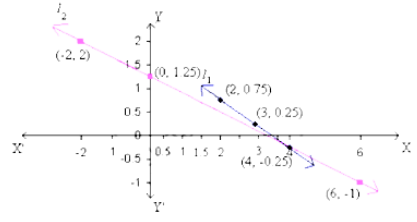
Plotting points $(2, 0.75), (3, 0.25), (3, 0.25), (4, -0.25)$ and joining them$,$ we get a line $l_1$ which is the graph of equation $(1).$
Again$, 3x + 8y = 10$
$\Rightarrow x=\frac{10-8 y}{3}$
Corresponding values of $x$ and $y$ can be tabulated as $:$
$x$ $6$ $-2$ $0$
$y$ $-1$ $2$ $1.25$
Plotting points $(6, 1), (2, 2), (0, 1.25)$ and joining them$,$ we get a line $l_2$ which is the graph of equation $(2).$
Image
The two lines $l_1$ and $l_2$ intersect at the point $(4, -0.25),$
​​​​​​​ i.e., $\left(4,-\frac{1}{4}\right)$..
Hence $x = 4$ and $y = \frac{-1}{4}$ is the unique solution of the given equations.

Need a full question paper?

Generate a complete, print-ready paper with questions like this in minutes — across 16+ boards, with answer keys.
Start Generating Free

Similar questions

A balloon is connected to a meteorological station by a cable of length 200 metres, inclined at 60 to the horizontal. Determine the height of the balloon from the ground, assuming that there is no slack in the string. (Take $\sqrt{3}=1.73$ )
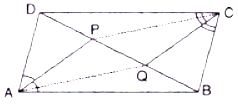
In the given figure, $A P$ is the bisector of $\angle A$ and $C Q$ is the bisector of $\angle C$ of parallelogram $\text{ABCD}$.

Prove that $\text{APCQ}$ is a parallelogram.
In a square $\text{ABCD}$, diagonals meet at $O. P$ is a point on $B C$ such that $O B=B P$.Show that:$(i) \angle POC =\left[22 \frac{1^{\circ}}{2}\right];(ii)\angle BDC =2 \angle POC;(iii)\angle BOP =3 \angle CPO$
Solve :$\frac{7+x}{5}-\frac{2 x-y}{4}=3 y-5;\frac{5 y-7}{2}+\frac{4 x-3}{6}=18-5 x$
Sum of the areas of two squares is $400 \sim cm^2$. If the difference of their perimeters is $16 \ cm$, find the sides of the two squares. 
Find the interior angles of the following triangles:
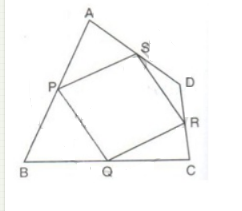
$\text{ABCD}$ is a quadrilateral $P, Q, R$ and $S$ are the mid$-$points of $AB, BC, CD$ and $AD$. Prove that $\text{PQRS}$ is a parallelogram.
Image
One year ago a man was four times as old as his son. After 6 years, his age exceeds twice his son's age by 9 years. Find their present ages.
Draw the graph of the equation$4x + 3y + 6 = 0$From the graph, find :$(i) y_1$, the value of y, when $x = 12.(ii) y_2$​​​​​​​, the value of $y$, when $x = - 6.$