Question
Solve the following equations graphically$:\ x-2 y=2 , \frac{x}{2}-y=1$

Answer

$x-2 y=2$
$\frac{x}{2}-y=1$
$x-2 y=2 ....(1)$
$\frac{x}{2}-y=1 ....(2)$
$x-2 y=2$
$\Rightarrow x=2+2 y$
Corresponding values of $x$ and $y$ can be tabulated as$ :$
$x$ $2$ $0$ $4$
$y$ $0$ $-1$ $1$
Again $\frac{x}{2}-y=1$
$\Rightarrow y =\frac{x}{2}-1$
Corresponding values of $x$ and $y$ can be tabulated as $:$​​​​​​​
$x$ $0$ $2$ $4$
$y$ $-1$ $0$ $1$
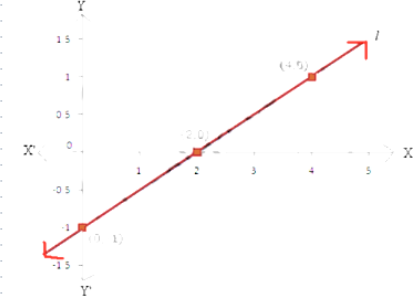
Plotting points $(0, -1), (2, 0), (4, 1)$ and joining them$,$ we get a line $l_1$ which is the graph for both the equation $(1)$ and $(2).$
Image
Hence$,$ the given system of equations has infinitely many solutions.

Need a full question paper?

Generate a complete, print-ready paper with questions like this in minutes — across 16+ boards, with answer keys.
Start Generating Free

Similar questions

A man lends $Rs. 12,500$ at $12\ \%\ $ for the first year, at $15\ \%\ $ for the second year and at $18\ \%\ $ for the third year. If the rates of interest are compounded yearly ; find the difference between the $C.I.$ fo the first year and the compound interest for the third year.
$A (-2, 4),C(4, 10)$ and $D(-2, 10)$ are the vertices of a square $\text{ABCD}$. Use the graphical method to find the co$-$ordinates of the fourth vertex $B$. Also, find:$(i)$ The co$-$ordinates of the mid$-$point of $BC;(ii)$ The co$-$ordinates of the mid$-$point of $CD$ and $(iii)$ The co$-$ordinates of the point of intersection of the diagonals of the square $\text{ABCD}.$
Draw the graph of a line $2x + 3y = 6$. From the graph, find the slope and $y-$intercept of the line.
Three equal cubes of sides $5\ cm$ each are placed to form a cuboid. Find the volume and the total surface area of the cuboid.
If $\sec A = \sqrt{2}$ , find :$\frac{3 \cot ^2 A +2 \sin ^2 A }{\tan ^2 A -\cos ^2 A }$.
Solve the following pairs of equations$:\ \frac{x}{3}+\frac{y}{4}=11,\frac{5 x}{6}-\frac{y}{3}=-7$
Using ruler and compasses only, construct a parallelogram $\text{ABCD}$ using the following data$: AB = 6 \ cm, AD = 3 \ cm$ and $\angle DAB = 45^o$. If the bisector of $\angle DAB$ meets $DC$ at $P$,prove that $\angle APB$ is a right angle.
$\text{PQR}$ is a triangle formed by the adjacent sides $PQ$ and $QR$ and diagonal $PR$ of a parallelogram $\text{PQRS}$. If in $\triangle PQR, \angle P : \angle Q : \angle R = 3 : 8 : 4$, Calculate the measures of all the angles of parallelogram $\text{PQRS}.$
Image ​​​​​​​
The present age of a man is 3 years more than three times the age of his son. Three years hence, the man's age will be 10 years more than twice the age of his son. Determine their present ages.
The difference between simple interest and compound interest compounded annually on a certain sum is $Rs.448$ for $2$ years at $8$ percent per annum. Find the sum.