Question
Solve the following equations graphically $:\ x + 4y + 9 = 0 , 3y = 5x - 1$

Answer

$x+4 y+9=0$
$3 y=5 x-1$
$x+4 y+9 .....(1)$
$3 y=5 x-1 .....(2)$
 Now, $x+4 y=-9$
$\Rightarrow x=-9-4 y$
Corresponding values of $x$ and $y$ can be tabulated as $:$
$x$ $4$ $-1$ $-5$
$y$ $-3$ $-2$ $-1$
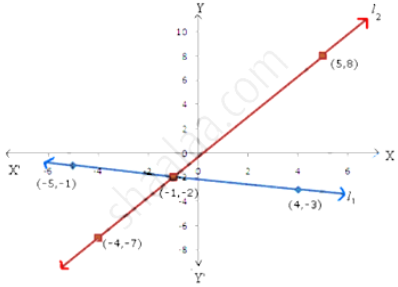
Plotting points $(4, -3), (-1, -2)$ and $(-5, -1)$ and joining them, we geta line $l_1$ which is the graph of equation $(!).$
Again$, 3y = 5 x -1$
$\Rightarrow y=\frac{5 x-1}{3}$
Corresponding values of $x$ and $y$ can be tabulated as $:$
$x$ $-4$ $-1$ $5$
$y$ $-7$ $-2$ $8$
Plotting points $(-4, -7), (-1, -2), (5, 8)$ and joining them we get a line $l_2$ which is the graph of equation $(2).$
Image
The two line $l_1$ and $l_2$ intersect at a unique point $(-1, -2)$.
​​​​​​​Thus$, x = -1$ and $y = -2$ is the unique solution of the given equations.

Need a full question paper?

Generate a complete, print-ready paper with questions like this in minutes — across 16+ boards, with answer keys.
Start Generating Free

Similar questions

The side of a square is $\frac{1}{2}(x+1)$ units, and its diagonals is $\frac{3-x}{\sqrt{2}}$
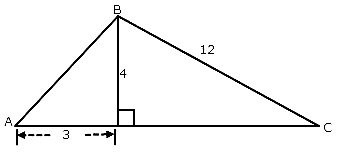
From the following figure, find the values of:$(i) \cos A;(ii)\operatorname{cosec} A;(iii) \tan ^2 A-\sec ^2 A;(iv) \sin C;(v)\sec C;(vi);\cot ^2 C-\frac{1}{\sin ^2 c}$
Draw the graph of the lines represented by the equations $x + y = 4$ and $2x - y = 2$ on the same graph. Find the coordinates of the point where they intersect
Solve the following system of equations graphically$:\ 2x = 23 - 3y , 5x = 20 + 8y.$Also$,$ find the area of the triangle formed by these lines and $x-$ax is in each graph.
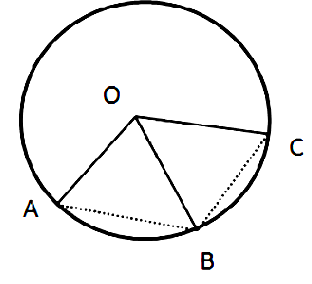
In the given figure, the lengths of arcs $AB$ and $BC$ are in the ratio $3:2.$ If $\angle AOB = 96^\circ $,find: $(i) \angle BOC ;(ii) \angle ABC$
Construct a trapezium $\text{ABCD}$, when:$AB= CD = 3.2 \ cm, BC = 6.0 \ cm, AD = 4.4 \ cm$ and $AD \| BC.$
Draw frequency polygons for each of the following frequency distribution: $(a)$ using histogram$(b)$ without using histogram
$C.I$ $10 - 30$ $30 - 50$ $50 - 70$ $70 - 90$ $90 - 110$ $110 - 130$ $130 - 150$
$ƒ$ $4$ $7$ $5$ $9$ $5$ $6$ $4$
Make $x$ the subject of the formula $y =\frac{1-x^2}{1+x^2}$, Find $x$, when $y =\frac{1}{2}$
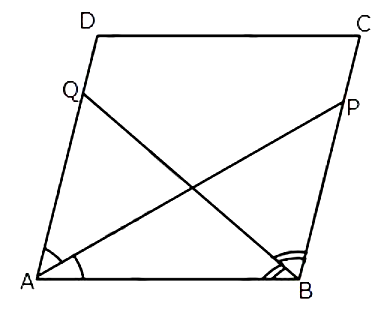
In the alongside diagram, $\text{ABCD}$ is a parallelogram in which $A P$ bisects angle $A$ and $B Q$ bisects angle $B$.

Prove that:$i. A Q=B P;ii. P Q=C D;iii. \text{ABPQ}$ is a parallelogram.
Solve the following simultaneous equations by the substitution method$:\ 7(y + 3) - 2(x + 2) = 14;4(y - 2) + 3(x - 3) = 2$