Question
Solve the following initial value problems:
$(1+\text{y}^2)\text{dx}+(\text{x}-\text{e}^{\tan^{-1}\text{y}})\text{dy}=0,\text{ y}(0)=0$

Answer

We have,
$(1+\text{y}^2)\text{dx}+(\text{x}-\text{e}^{\tan^{-1}\text{y}})\text{dy}=0$
$\Rightarrow(\text{x}-\text{e}^{\tan^{-1}\text{y}})\frac{\text{dy}}{\text{dx}}=-(1+\text{y}^2)$
$\Rightarrow(1+\text{y}^2)\frac{\text{dx}}{\text{dy}}=-(\text{x}-\text{e}^{\tan^{-1}\text{y}})$
$\Rightarrow\frac{\text{dx}}{\text{dy}}+\frac{\text{x}}{1+\text{y}^2}=\frac{\text{e}^{-\tan^{-1}\text{y}}}{1+\text{y}^2}\ ...(1)$
Clearly, it is a linear differential equation of the form
$\frac{\text{dy}}{\text{dx}}+\text{Px}=\text{Q}$
Where $\text{P}=\frac{1}{1+\text{y}^2}$ and $\text{Q}=\frac{\text{e}^{-\tan^{-1}\text{y}}}{1+\text{y}^2}$
$\therefore\text{ I.F.}=\text{e}^{\int\text{Pdy}}$
$=\text{e}^{\int\frac{1}{1+\text{y}^2}\text{dy}}$
$=\text{e}^{\tan^{-1}\text{y}}$
Multiplying both sides of (1) by $\text{I.F.}=\text{e}^{\tan^{-1}\text{y}},$ we get
$\text{e}^{\tan^{-1}\text{y}}\Big(\frac{\text{dx}}{\text{dy}}+\frac{\text{x}}{1+\text{y}^2}\Big)=\text{e}^{\tan^{-1}\text{y}}\frac{\text{e}^{-\tan^{-1}\text{y}}}{1+\text{y}^2}$
$\Rightarrow\text{e}^{\tan^{-1}\text{y}}\Big(\frac{\text{dx}}{\text{dy}}+\frac{\text{x}}{1+\text{y}^2}\Big)=\frac{1}{1+\text{y}^2}$
Integrating both sides with respect to y, we get
$\text{e}^{\tan^{-1}\text{y}}\text{x}=\int\frac{1}{1+\text{y}^2}\text{dy}+\text{C}$
$\Rightarrow\text{x}\text{e}^{\tan^{-1}\text{y}}=\tan^{-1}\text{y}+\text{C}\ ...(2)$
Now,
$\text{y}(0)=0$
$\therefore\ 0\times\text{e}^{0}=0+\text{C}$
$\Rightarrow\text{C}=0$
Putting the value of C in (2), we get
$\text{x}\text{e}^{\tan^{-1}\text{y}}=\tan^{-1}\text{y}+0$
$\Rightarrow\text{x}\text{e}^{\tan^{-1}\text{y}}=\tan^{-1}\text{y}$
Hence, $\text{x}\text{e}^{\tan^{-1}\text{y}}=\tan^{-1}\text{y}$ is the required solution.

Need a full question paper?

Generate a complete, print-ready paper with questions like this in minutes — across 16+ boards, with answer keys.
Start Generating Free

Similar questions

If the area bounded by the parabola $\text{y}^{2} = 16\text{ax}$ and the line $\text{y = 4 mx}$ is  $\frac{\text{a}^{2}}{12}$ sq. units, then using integration, find the value of m.
Find the differential equation of the family of curve $\text{y}=\text{Ae}^\text{2x}+\text{Be}^{-2\text{x}},$ where A and B are arbitrary constants.
Solve the system of equations:
$\frac{2}{\text{x}}+\frac{3}{\text{y}}+\frac{10}{\text{z}}=4$
$\frac{4}{\text{x}}-\frac{6}{\text{y}}+\frac{5}{\text{z}}=1$
$\frac{6}{\text{x}}+\frac{9}{\text{y}}-\frac{20}{\text{z}}=2$
Verify Rolle's theorem for the function $f ( x) = x^{2} - 5x + 4\text{ on} [ 1, 4].$
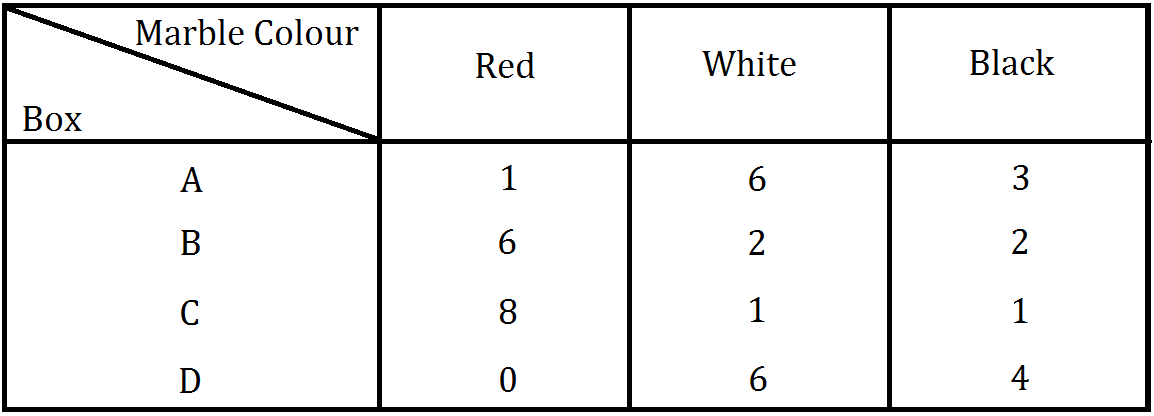
Suppose we have four boxes A, B, C, D containing coloured marbles as given below:

One of the boxes has been selected at random and a single marble is drawn from it. If the marble is red, what is the probability that it was drawn from,

  1. Box A?
  2. Box B?
  3. Box C?
If $\text{y}=500\text{e}^{7\text{x}}+600\text{e}^{-7\text{x}}$ prove that $\frac{\text{d}^2\text{y}}{\text{dx}^2}=49\text{y}.$
$\int\frac{\text{x}^2+5\text{x}+2}{\text{x}+2}\text{dx}$
Evalute the following integrals:
$\int\frac{\sec\text{x}}{\log(\sec\text{x}+\tan\text{x})}\text{dx}$
Evaluate the following integrals:

$\int\frac{\text{x}}{\text{x}^4-\text{x}^2+1}\text{dx}$

The function f(x) is befined as follows: $\text{f(x)}=\begin{cases}\text{x}^2+\text{ax}+\text{b},&0\leq\text{x}<2\\3\text{x}+2,&2\leq\text{x}\leq4\\2\text{ax}+5\text{b},&4<\text{x}\leq8\end{cases}$ if is continuous on [0, 8] find the value of a and b.