Question
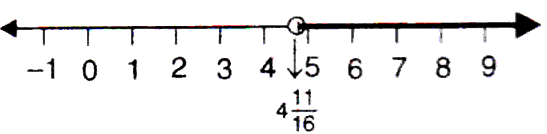
Solve the following linear in-equation and graph the solution set on a real number line:
$2(3x-5) > 5(13-2x), x \in W$

Answer

$2(3 x-5)>5(13-2 x) $
$6 x-10>65-10 x $
$6 x+10 x>65+10 $
$16 x>75 $
$x>\frac{75}{16} $
$c>4 \frac{11}{16}$
Solution set $=\left[x>4 \frac{11}{16}\right]$

Need a full question paper?

Generate a complete, print-ready paper with questions like this in minutes — across 16+ boards, with answer keys.
Start Generating Free

Similar questions

In triangle LMN, bisectors of interior angles at L and N intersect each other at point A. prove that:
(i) Point A is equidistant from all the three sides of the triangle.
(ii) AM bisects angle LMN.
Simplify: $\frac{\sin A}{\cot A+\operatorname{cosec} A}-\frac{\sin A}{\cot A-\operatorname{cosec} A}$
If p, q and r in continued proportion, then prove the following:
$(p + q + r )(p - q + r) = p^2 + q^2 + r^2$
The length of a rectangular garden is $12 m$ more than its breadth. The numerical value of its area is equal to $4$ times the numerical value of its perimeter. Find the dimensions of the garden.
A man sold some Rs. 100 shares paying 10% dividend at a discount of 25% and invested the proceeds in Rs. 100 shares paying 16% dividend quoted at Rs. 80 and thus increased his income by Rs. 2000. Find the number of shares sold by him.
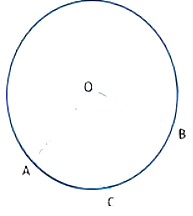
In following figure , C is a point on the minor arc AB of the circle with centre O . Given ∠ ACB = p° , ∠ AOB = q° , express q in terms of p. Calculate p if OACB is a parallelogram.
Solve the following quadratic equation:
$4x^2- 4ax + (a^2 - b^2) = 0$ where $a , b ∈ R$.
Show that the lines 2x + 5y = 1, x – 3y = 6 and x + 5y + 2 = 0 are concurrent.
A triangle ABC lies in the co-ordinate plane. The co-ordinates of its vertices are A (2, 3), B ( 4,-4) and C (6 ,-7). This triangle is reflected in the line y=O onto LA'B'C'. LA'B'C' is then reflected in the origin ontolA"B"C". Write down the co-ordinates of LA'B'C' and LA "B" C".
If $b$ is the mean proportion between $a$ and $c$, show that $b(a+c)$ is the mean proportion between $\left(a^2+b^2\right)$ and $\left(b^2+c^2\right)$.