Question
Solve the following linear programming problem by graphical method.Under the constraints, maximise $Z=60 x+40 y$.
$
\begin{aligned}
x+2 y & \leq 12 \\
2 x+y & \leq 12 \\
x+\frac{5}{4} y & \geq 5 ; x \geq 0, y \geq 0
\end{aligned}
$
Answer

The given constraints are as follows :
$
\begin{aligned}
x+2 y & \leq 12\quad \quad \ldots \ldots(1) \\
2 x+y & \leq 12\quad \quad \ldots \ldots(2) \\
x+\frac{5}{4} y & \geq 5 \quad \quad \ldots \ldots(3)\\
x \geq 0, y & \geq 0\quad \quad \ldots \ldots(4)
\end{aligned}
$
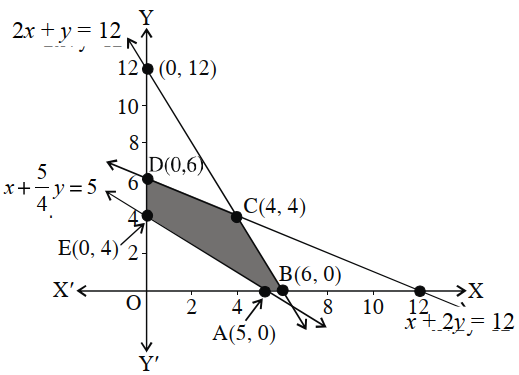
We draw the graph of the constraints (1) to (4). As shown with figure, the feasible region is ABCDE (shaded) which has been determined by the constraints (1) to (4). On observation we find that the feasible region is bounded.
Image
The coordinates of the corner points $A , B , C , D$ and E and respectively $(5,0),(6,0),(4,4),(0,6)$ and $(0,4)$.
Corner PointValue of Z = 60x + 40y
(5,0)300
(6,0)360
(4, 4)400 ← Maximum
(0,6)240
(0,4)1600

We see that at the point (4, 4), the value of Z is maximum.

Need a full question paper?

Generate a complete, print-ready paper with questions like this in minutes — across 16+ boards, with answer keys.

Start Generating Free

Similar questions

The contents of three urns are as follows:
Urn $1 : 7$ white, $3$ black balls,
Urn $2 : 4$ white, $6$ black balls,
Urn $3 : 2$ white, $8$ black balls.
One of these urns is chosen at random with probabilities $0.20, 0.60$ and $0.20$ respectively. From the chosen urn two balls are drawn at random without replacement. If both these balls are white, what is the probability that these came from urn $3$?
An item is manufactured by three machines $A, B$ and $C$. Out of the total number of items manufactured during a specified period, $50\%$ are manufactured on $A, 30\%$ on $B$ and $20\%$ on $C. 2\%$ of the items produced on $A$ and $2\%$ of items produced on $B$ are defective, and $3\%$ of these produced on $C$ are defective. All the items are stored at one godown. One item is drawn at random and is found to be defective. What is the probability that it was manufactured on machine A?
Draw a rough sketch of the region $\{(x, y) : y^2 < 5x, 5x^2 + < 36\}$ and find the area by the region using mwthod of integration.
Integrate the function in Exercise:
$\sin^{-1}\Big(\frac{2\text{x}}{1+\text{x}^2}\Big)$
If the sum of the surface areas of cube and a sphere is constant, what is the ratio of an edge of the cube to the diameter of the sphere, when the sum of their volumes is minimum?
Find the distance of the point P(3, 4, 4) from the point, where the line joining the points A(3, -4, -5) and B(2, -3, 1) intersects the plane 2x + y + z = 7.
A merchant plans to sell two types of personal computers- a desktop model and a portable model that will cost Rs 25000 and Rs 40000 respectively. He estimates that the total monthly demand of computers will not exceed 250 units. Determine the number of units of each type of computers which the merchant should stock to get maximum profit if he does not want to invest more than Rs 70 lakhs and if his profit on the desktop model is Rs 4500 and on portable model is Rs 5000.
Evaluate the following determinant:
$\begin{vmatrix}1&3&9&27\\3&9&27&1\\9&27&1&3\\27&1&3&9 \end{vmatrix}$
A manufacturer has three machines installed in his factory. machines $I$ and $II$ are capable of being operated for at most $12$ hours whereas Machine $III$ must operate at least for $5$ hours a day. He produces only two items, each requiring the use of three machines. The number of hours required for producing one unit each of the items on the three machines is given in the following table:
Item Number of hours required by the machine
  $I$ $II$ $III$
$A$ $1$ $2$ $1$
$B$ $2$ $1$ $\frac{5}{4}$
He makes a profit of $Rs. 6.00$ on item $A$ and $Rs. 4.00$ on item $B.$ Assuming that he can sell all that he produces, how many of each item should he produces so as to maximize his profit? Determine his maximum profit. Formulate this $\text{LPP}$ mathematically and then solve it.
Evaluate the following integrals:
$\int\limits_{0}^{1}\text{x}\log(1+2\text{x})\text{dx}$