Question
Solve the following linear programming problem by graphical method.Under the constraints, maximise $Z=60 x+40 y$.
$
\begin{aligned}
x+2 y & \leq 12 \\
2 x+y & \leq 12 \\
x+\frac{5}{4} y & \geq 5 ; x \geq 0, y \geq 0
\end{aligned}
$
Answer

The given constraints are as follows :
$
\begin{aligned}
x+2 y & \leq 12\quad \quad \ldots \ldots(1) \\
2 x+y & \leq 12\quad \quad \ldots \ldots(2) \\
x+\frac{5}{4} y & \geq 5 \quad \quad \ldots \ldots(3)\\
x \geq 0, y & \geq 0\quad \quad \ldots \ldots(4)
\end{aligned}
$
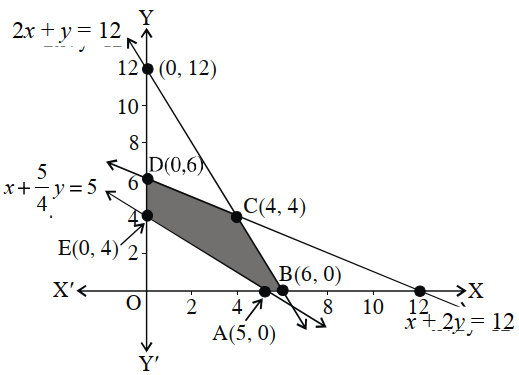
We draw the graph of the constraints (1) to (4). As shown with figure, the feasible region is ABCDE (shaded) which has been determined by the constraints (1) to (4). On observation we find that the feasible region is bounded.
Image
The coordinates of the corner points $A , B , C , D$ and E and respectively $(5,0),(6,0),(4,4),(0,6)$ and $(0,4)$.
Corner PointValue of Z = 60x + 40y
(5,0)300
(6,0)360
(4, 4)400 ← Maximum
(0,6)240
(0,4)1600

We see that at the point (4, 4), the value of Z is maximum.

Need a full question paper?

Generate a complete, print-ready paper with questions like this in minutes — across 16+ boards, with answer keys.

Start Generating Free

Similar questions

A company manufactures two types of novelty souvenirs made of plywood. Souvenirs of type A require 5 minutes each for cutting and 10 minutes each for assembling. Souvenirs of type B require 8 minutes each for cutting and 8 minutes each for assembling. There are 3 hours 20 minutes available for cutting and 4 hours for assembling. The profit is Rs. 5 each for type A and Rs. 6 each for type B souvenirs. How many souvenirs of each type should be manufactured for maximum profit.
If given function is continuous at $x =0$ then write the value of $k$.
$f(x)=\left\{\begin{array}{cl}\frac{\log (1+a x)-\log (1-b x)}{x}, & x \neq 0 \\ k, & x=0\end{array}\right.$
Maximize $Z=4 x+y$ subject to constraints $x+y$ $\leq 50,3 x+y \leq 90, x \geq 0, y \geq 0$ by using graphical method.
Minimize $Z = x +2 y$ subject to constraints
$2 x+2 y \geq 3 ;$
$x+2 y \geq 6 ;$
$x, y \geq 0$
using graphical method.
Solve the following LPP using graphical method
$
\begin{array}{ll}
\text { Minimize } & Z=600 x+400 y \\
\text { constraints } & x+2 y>12 \\
& 2 x+y<12 \\
& x+\frac{5}{4} y \geq 5 \\
& x>0, y>0
\end{array}
$
Find the value of $\int_{\pi / 6}^{\pi / 3} \frac{d x}{1+\sqrt{\tan x}}$
Integrate the function: $\frac{\sqrt{\tan x}}{\sin x \cos x}$
Solve the following LPP using graphical method
$
\begin{array}{cc}
\operatorname{minimize} & z=200 x+500 y \\
\text { constraints } & x+2 y \geq 10 \\
& 3 x+4 y \leq 24 \\
& x \geq 0, y \geq 0
\end{array}
$
Find shortest distance between lines $l_1$ and $l_2$. The vector equations of lines are $\vec{r}=\overparen{i}+\overparen{j}+\lambda(2 \overparen{i}-\overparen{j}+\overparen{k})$ and $\vec{r}=2 \overparen{i}+\overparen{j}-\overparen{k}+\mu(3 \overparen{i}-5 \overparen{j}+2 \overparen{k})$
Prove that $
\tan \left(\frac{\pi}{4}+\frac{1}{2} \cos ^{-1} \frac{x}{y}\right)+\tan \left(\frac{\pi}{4}-\frac{1}{2} \cos ^{-1} \frac{x}{y}\right)=\frac{2 y}{x}
$