Question
Solve the following linear programming problem graphically:
Maximise Z = 4x + y subject to the constraints: 
x + y $\le$ 50
3x + y $\le$ 90
x $\ge$ 0, y $\ge$ 0
Answer

To Maximize Z = 4x + y ......(i)
subject to the constraints:
x + y $\le$ 50  .....(ii)
3x + y $\le$ 90 ......(iii)
x $\ge$ 0, y $\ge$ 0 .....(iv)
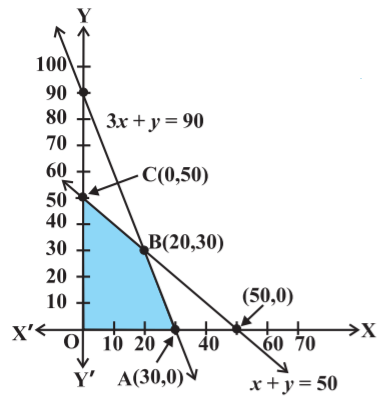
The shaded region in a figure is the feasible region determined by the system of constraints (ii) to (iv). We observe that the feasible region OABC is bounded. So, we now use Corner Point Method to determine the maximum value of Z.
The coordinates of the corner points O, A, B and C are (0, 0), (30, 0), (20, 30) and (0, 50) respectively. Now we evaluate Z at each corner point.

Corner Point Corresponding value of Z
(0, 0) 0
(30, 0) 120
(20, 30) 110
(0, 50) 50


Hence, maximum value of Z is 120 at the point (30, 0).

Need a full question paper?

Generate a complete, print-ready paper with questions like this in minutes — across 16+ boards, with answer keys.

Start Generating Free

Similar questions

Form the differential equation corresponding to $\text{y}^2=\text{a}(\text{b}-\text{x}^2)$ bt eliminating a and b.
 Let $\text{F}(\alpha)=\begin{bmatrix}\cos\alpha & -\sin\alpha & 0 \\ \sin\alpha & \cos\alpha & 0 \\ 0 & 0 & 1\end{bmatrix}$ and$\text{G}(\beta)=\begin{bmatrix} \cos\beta & 0 & \sin\beta \\ 0 & 1 & 0 \\ -\sin\beta & 0 & \cos\beta \end{bmatrix}$
Show that$\big[\text{G}(\beta)\big]^{-1}=\text{G}(-\beta)$
A is known to speak truth $3$ times out of $5$ times. He throws a die and reports that it is one. Find the probability that it is actually one.
Integrate the function: $\frac{x}{\sqrt{x+4}}, x>0$
Consider the binary operation * on the set {1, 2, 3, 4, 5} defined by a * b =min. {a, b}. Write the operation table of the operation *.
Find the area of the parallelogram whose diagonals are:
$3\hat{\text{i}}+4\hat{\text{j}}$ and $\hat{\text{i}}+\hat{\text{j}}+\hat{\text{k}}$
Let $\vec{\text{a}}=5\hat{\text{i}}-\hat{\text{j}}+7\hat{\text{k}}$ and $\vec{\text{b}}=\hat{\text{i}}-\hat{\text{j}}+\lambda\hat{\text{k}}.$ Find $\lambda$ such that $\vec{\text{a}}+\vec{\text{b}}$ is orthonal to $\vec{\text{a}}-\vec{\text{b}}.$
Evaluate the following integrals:
$\int\cos\text{x}\sqrt{4-\sin^2\text{x}}\text{dx}$
Find the derivative of the function f defined by f(x) = mx + c at x = 0.
It the lines $\frac{\text{x}-1}{-3}=\frac{\text{y}-2}{2\lambda}=\frac{\text{z}-3}{2}$ and $\frac{\text{x}-1}{3\lambda}=\frac{\text{y}-2}{1}=\frac{\text{z}-6}{-5}$ are perpendicular, find the value of $\lambda.$