Question
Solve the following linear programming problem graphically:
Minimise Z = 200x + 500y subject to the constraints:
$x + 2 y \geq 10$
$3 x + 4 y \leq 24$
$x \geq 0 , y \geq 0$

Answer

According to the question, the linear constraints
$x + 2 y \geq 10$
$3 x + 4 y \leq 24$
and $x \geq 0 , y \geq 0$
and objective function is Min $(Z) = 200x + 500y.$
Reducing the above inequations into equations
$x + 2y = 10$ ...(i)
$3x + 4y = 24$ ...(ii)
$x = 0, y = 0$ ...(iii)

Equations Point of Intersection
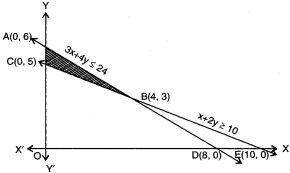
(i) and (ii) x = 4 and y = 3
  $\Rightarrow$ Point is $ (4, 3)$
(i) and (iii) when x = 0 $\Rightarrow$ y = 5
  when y = 0 $\Rightarrow$ x = 10
  $\Rightarrow$ Points are $(0, 5), (10, 0)$
(ii) and (iii) when x = 0 $\Rightarrow$ y = 6
  when y = 0 $\Rightarrow$ x = 8
  $\Rightarrow$ Points are $(0, 6) and (8, 0)$


For $x + 2 y \geq 10$, putting x = 0 and y = 0
$\Rightarrow 0 + 0 \geq 10 \Rightarrow 0 \geq 10$ i.e., Not true
$\Rightarrow$ The shaded region will be away from origin.
Likewise, for $3 x + 4 y \leq 24$, putting x = 0 and y = 0 $\Rightarrow 0 + 0 \leq 24 \Rightarrow 0 \leq 24$ i.e. true
$\Rightarrow$ the shaded region will be toward the origin
Also, we have, $x \geq 0$ and $y \geq 0$, indicates that the shaded part will exist in first quadrant only. Here, feasible region or bounded region will be $ABCA$, having corner points as $A(0,6) B(4, 3)\ and\ C(0, 5)$. For optimal point substituting the value of all-corner points in $Z = 200x + 500y$

Corner points Z
$A (0, 6)$ $3000$
$B (4, 3)$ $2300$ $\to$ Minimum
$C (0, 5)$ $2500$

$\Rightarrow$ The minimum value of ‘Z’ is 2300, exist at B (4, 3). Here point B is known as optimal point and min(Z) as optimal solution.

Need a full question paper?

Generate a complete, print-ready paper with questions like this in minutes — across 16+ boards, with answer keys.

Start Generating Free

Similar questions

Evaluate the following definite integrals:
$\int_{0}^\limits{1}\Big(\text{xe}^{2\text{x}}+\sin\frac{\pi\text{x}}{2}\Big)\text{dx}$
If $\vec{\text{a}}$ are $\vec{\text{b}}$ are unit vectors, then find the between $\vec{\text{a}}$ and $\vec{\text{b}},$ given that $\big(\sqrt{3}\vec{\text{a}}-​\vec{\text{b}}\big)$ is aunit vector.
If $​​\vec{\text{a}}+​​\vec{\text{b}}​​+\vec{\text{c}}=\vec{0,}$ show that the angle $\theta$ between the vectors $​​\vec{\text{b}}$ and $\vec{\text{c}}$ is given by $\cos\theta=\frac{|\vec{\text{a}}|^2-\big|\vec{\text{b}}\big|^2-|\vec{\text{c}}|^2}{2\big|\vec{\text{b}}\big||\vec{\text{c}}|}.$
For what value of k is the following function continuous at x = 1
$\text{f}\text{(x)}=\begin{cases}\frac{\text{x}^2-1}{\text{x}-1}, & \text{x} \neq 1\\\text{k}, & \text{x}= 1\end{cases}$ 
Write the coordinates of the point at which the tangent to the curve $y = 2x^2 - x + 1$ is parallel to the line $y = 3x + 9.$
$\int\limits^{\frac{\pi}{2}}_{\frac{\pi}{3}}\frac{\sqrt{1+\cos\text{x}}}{(1-\cos\text{x})^{\frac{5}{2}}}$
Prove that $\sin^{–1} \Bigg(\frac{8}{17}\Bigg)+\sin^{-1}\Bigg(\frac{3}{5}\Bigg)=\cos^{-1}\Bigg(\frac{36}{85}\Bigg).$
If $A$ and $B$ are square matrices of the same order such that $AB = BA,$ then prove by induction that $AB’’ = B’’A.$ Further prove that $(AB)’’ = A’’B’’$ for all $n \Rightarrow N.$
Find the projection of $\vec{\text{b}}+\vec{\text{c}}$ on $\vec{\text{a}},$ where $\vec{\text{a}}=2\hat{\text{i}}-2\hat{\text{j}}+\hat{\text{k}},\vec{\text{b}}=\hat{\text{i}}+2\hat{\text{j}}-2\hat{\text{k}}$ and $\vec{\text{c}}=2\hat{\text{i}}-\hat{\text{j}}+4\hat{\text{k}}.$
Find the integrals of the functions in Exercises:
$\tan^4\text{x}$