Question
Solve the following quadratic equations by factorization:
$\frac{1}{\text{x}-2}+\frac{2}{\text{x}-1}=\frac{6}{\text{x}},$ $\text{x}\neq0$

Answer

We have, $\frac{1}{\text{x}-2}+\frac{2}{\text{x}-1}=\frac{6}{\text{x}},$ $\text{x}\neq0$
$\Rightarrow\frac{(\text{x}-1)+2(\text{x}-2)}{(\text{x}-2)(\text{x}-1)}=\frac{6}{\text{x}}$
$\Rightarrow\frac{\text{x}-1+2\text{x}-4}{\text{x}^2-2\text{x}-\text{x}+2}=\frac{6}{\text{x}}$
$\Rightarrow\frac{3\text{x}-5}{\text{x}^2-3\text{x}+2}=\frac{6}{\text{x}}$
$\Rightarrow x(3x - 5) = 6(x^2 - 3x + 2)$
$\Rightarrow 3x^2 - 5x = 6x^2 - 18x + 12$
$\Rightarrow 3x^2 - 18x + 5x + 12 = 0$
$\Rightarrow 3x^2 - 13x + 12 = 0$
[$\because$ 3 × 18 = 36
⇒ -9x - 4 and $-13 = -9 - 4]$
$\Rightarrow 3x^2 - 9x - 4x + 12 = 0$
$\Rightarrow 3x(x - 3) - 4(x - 3) = 0$
$\Rightarrow (x - 3)(3x - 4) = 0$
$\Rightarrow x = 3$ or $\text{x}=\frac{4}{3}$
$\therefore$ x = 3 and $\text{x}=\frac{4}{3}$ are the two roots of the given equation.

Need a full question paper?

Generate a complete, print-ready paper with questions like this in minutes — across 16+ boards, with answer keys.
Start Generating Free

Similar questions

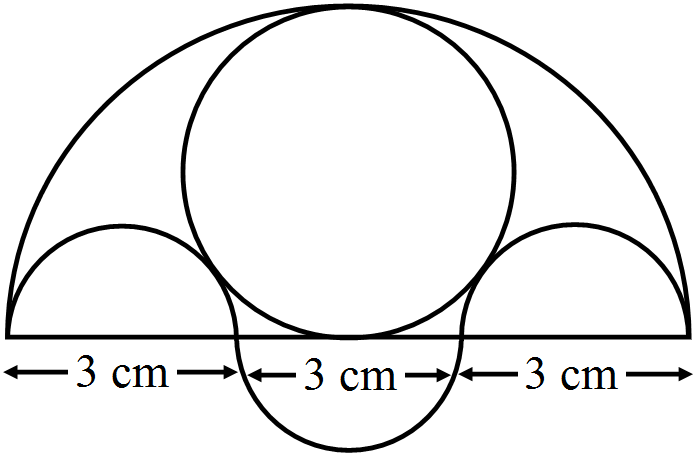
Three semicircles each of diameter 3cm, a circle of diameter 4.5,cm and a semicircle of radius 4.5cm are drawn in the given figure. Find the area of the shaded region. $\Big[\text{Use }\pi=\frac{22}{7}\Big]$
A tent of height 77 dm is in the form a right circular cylinder of diameter 36 m and height 44 dm surmounted by a right circular cone. Find the cost of the canvas at Rs. 3.50 per $m ^2$. [use $\left.\pi=\frac{22}{7}\right]$
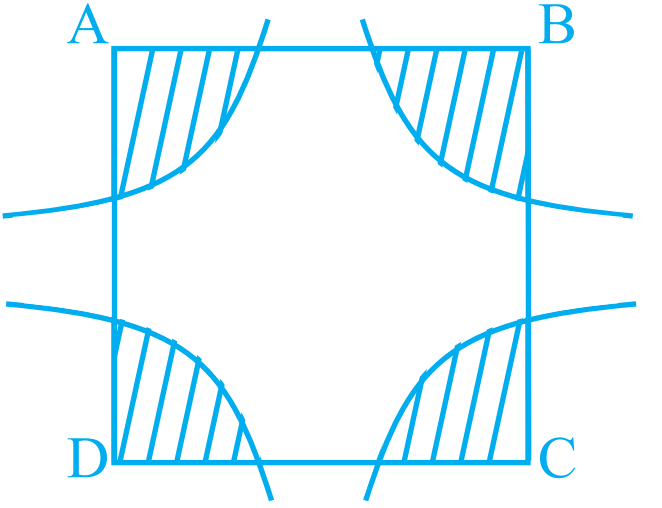
In Fig. arcs have been drawn of radius $21\ cm$ each with vertices $A, B, C$ and $D$ of quadrilateral $\text{ABCD}$ as centres. Find the area of the shaded region.
Half the perimeter of a rectangular garden, whose length is 4 m more than its width, is 36 m. find the dimensions of the garden.
Find the roots of the following equation, if they exist, by applying the quadratic formula:
$x^2 - 4ax - b^2 + 4a^2 = 0$
Prove that parallelogram circumscribing a circle is a rhombus.
Which term of the arithmetic progression 8, 14, 20, 26, ... will be 72 more than its $41^{st}$ term.
Find the area of the triangle whose sides are 18cm, 24cm and 30cm. Also, find the height corresponding to the smallest side.
The sum of the digits of a two-digit number is 9. Also, nine times this number is twice the number obtained by reversing the order of the digits. Find the number.
On dividing, $3x^3+ x^2 + 2x + 5 $by a polynomial g(x), the quotient and remainder are 3x - 5 and 9x + 10 respectively. Find g(x)
Hint: $\text{g}(\text{x})=\frac{(\text{3x}^3+\text{x}^2+\text{2x}+5)-(\text{9x}+10)}{(\text{3x}-5)}$