Question
Solve the following quadratic equations by factorization:
$25x(x + 1) = -4$

Answer

We have been given
$25x(x + 1) = -4$
$25x^2 + 25x + 4 = 0$
$25x^2 + 20x + 5x + 4 = 0$
$5x(5x + 4) + 1(5x + 4) = 0$
$(5x + 1)(5x + 4) = 0$
Therefore,
$5x + 1 = 0$
$5x = -1$
$\text{x}=\frac{-1}{5}$
Or,$ 5x + 4 = 0$
$5x = -4$
$\text{x}=\frac{-4}{5}$
Hence, $\text{x}=\frac{-1}{5}$ or $\text{x}=\frac{-4}{5}$

Need a full question paper?

Generate a complete, print-ready paper with questions like this in minutes — across 16+ boards, with answer keys.
Start Generating Free

Similar questions

Prove that the points $(0, 0), (5, 5)$ and $(-5, 5)$ are the vertices of a right isosceles triangle.
Determine the ratio in which the straight line x - y - 2 = 0 divides the line segment joining (3, -1) and (8, 9).
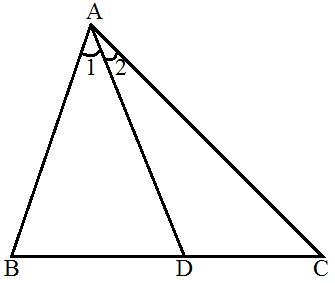
In $\triangle\text{ABC}$ (Fig.), if $\angle1=\angle2,$ prove that $\frac{\text{AB}}{\text{AC}}=\frac{\text{BD}}{\text{DC}}.$
The sum of the first n terms of an A.P. is $ 4n^2 + 2n.$ Find the $n^{th}$ term of this A.P.
Find the zeros of the following quadratic polynomial and verify the relationship between the zeros and their coefficients:
$g(s) = 4s^2 - 4s + 1$
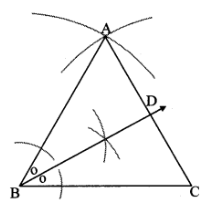
i. Draw a ∆ABC.
ii. Bisect ∠B and name the point of intersection of AC and the angle bisector as D.
iii. Measure the sides.
AB = ⬜ cm, BC = ⬜ cm,
AD = ⬜ cm, DC = ⬜ cm
iv. Find ratios $\frac{A B}{B C}$ and $\frac{A D}{D C}$
v. You will find that both the ratios are almost equal.
vi. Bisect remaining angles of the triangle and find the ratios as above.
Verify that the ratios are equal.
Image
$\frac{ AB }{ BC }=\frac{4}{4}=1$$\quad$$\quad$(i)
$\frac{ AD }{ DC }=\frac{2}{2}=1$$\quad$$\quad$(ii)
$\therefore \quad \frac{ AB }{ BC }=\frac{ AD }{ DC }$...[From (i) and (ii)]
Smt. Deshpande purchased shares of FV Rs. 5 at a premium of Rs. 20. How many shares will she get for Rs. 20,000?
Solve : $\frac{1}{3} x+\frac{1}{4} y=4 ; \frac{5}{6} x-\frac{1}{8} y=4$
Find the smallest number which when divided by $28$ and $32$ leaves remainders $8$ and $12$ respectively.
The roots of each of the following quadratic equation are real and equal, find k.
$3 y^2+k y+12=0$