Question
Solve the following quadratic equations by factorization:
$3\sqrt{5}\text{x}^2+25\text{x}-10\sqrt{5}=0$

Answer

$3\sqrt{5}\text{x}^2+25\text{x}-10\sqrt{5}=0$
$\sqrt{5}\bigg(3\text{x}^2+\frac{25}{\sqrt{5}}\text{x}-\frac{10\sqrt{5}}{\sqrt{5}}\bigg)=0$
$\Rightarrow\sqrt{5}\big[3\text{x}^2+5\sqrt{5}\text{x}-10\big]=0$
$\big(\text{Dividing by}\sqrt{5}\big)$
$\Rightarrow\big[3\text{x}^2-\sqrt{5}\text{x}+6\sqrt{5}\text{x}-10\big]=0$
$\Rightarrow3\text{x}^2-\sqrt{5}\text{x}+6\sqrt{5}\text{x}-10=0$
$\Rightarrow\text{x}\big(3\text{x}-\sqrt{5}\big)+2\sqrt{5}\big(3\text{x}-\sqrt{5}\big)=0$
$\Rightarrow\big(3\text{x}-\sqrt{5}\big)\big(\text{x}+2\sqrt{5}\big)=0$
Either $3\text{x}-\sqrt{5}=0,$ then $3\text{x}=\sqrt{5}$
$\Rightarrow\text{x}=\frac{\sqrt{5}}{3}$
or $\text{x}+2\sqrt{5}=0,$ then $\text{x}=-2\sqrt{5}$
$\therefore\text{x}=\frac{\sqrt{5}}{3},-2\sqrt{5}$

Need a full question paper?

Generate a complete, print-ready paper with questions like this in minutes — across 16+ boards, with answer keys.
Start Generating Free

Similar questions

Ajay sharma repays the borrowed amount of ₹ 3,25,000 by paying ₹ 30500 in the first month and then decreases the payment by ₹ 1500 every month. How long will it take to clear his amount?
Kargil’s temperature was recorded in a week from Monday to Saturday. All readings were in A.P. The sum of temperatures of Monday and Saturday was 5° C more than sum of temperatures of Tuesday and Saturday. If temperature of Wednesday was – 30° celsius then find the temperature on the other five days.
Mr. D'souza purchased 200 shares of FV Rs. 50 at a premium of Rs. 100. He received 50% dividend on the shares. After receiving the dividend he sold 100 shares at a discount of Rs. 10 and remaining shares were sold at a premium of Rs. 75. For each trade he paid the brokerage of Rs. 20. Find whether Mr. D'souza gained or incurred a loss? by how much?
If p, q are prime positive integers, prove that $\sqrt{\text{p}}+\sqrt{\text{qp + q}}$ is an irrational number.
If the sum of first p terms of an A.P. is equal to the sum of first q terms then show that the sum of its first (p + q) terms is zero. (p ≠ q)
Evaluate the following:
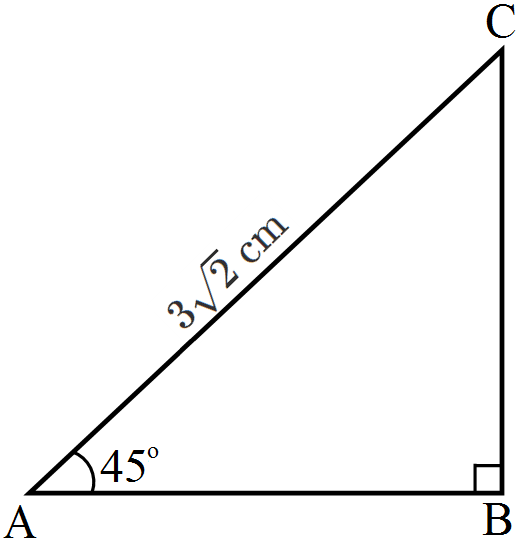
In the adjoining figure, $\triangle\text{ABC}$ is a right-angled at B and $\angle\text{A}=45^\circ,$ If $\text{AC}=3\sqrt{2}\text{cm},$
Find:
  1. BC.
  2. AB.
The following table shows the classification of percentages of marks of students and the number of students. Draw a frequency polygon from the table.
Result
(Percentage)
30-4040-5050-6060-7070-8080-9090-100
No. of students733456547185
A and B each have a certain number of mangoes. A says to B, "if you give 30 of your mangoes, I will have twice as many as left with you." B replies, "if you give me 10, I will have thrice as many as left with you." How many mangoes does each have?
A two-digit number is such that the product of its digit is 18. When 63 is subtracted from the number, the digits interchange their places. Find the number.
Solve the following quadratic equation.
$\frac{1}{x+5}=\frac{1}{x^2}$