Question
Solve the following quadratic equations by factorization:
$3\text{x}^2-2\sqrt{6}\text{x}+2=0$

Answer

We have been given
$3\text{x}^2-2\sqrt{6}\text{x}+2=0$
$3\text{x}^2-\sqrt{6}\text{x}-\sqrt{6}\text{x}+2=0$
$\sqrt{3}\text{x}\big(\sqrt{3}\text{x}-\sqrt{2}\big)-\sqrt{2}\big(\sqrt{3}\text{x}-\sqrt{2}\big)=0$
$\big(\sqrt{3}\text{x}-\sqrt{2}\big)(\sqrt{3}\text{x}-\sqrt{2})=0$
Therefore,
$\sqrt{3}\text{x}-\sqrt{2}=0$
$\sqrt{3}\text{x}=\sqrt{2}$
$\text{x}=\sqrt{\frac{2}{3}}$
Hence, $\text{x}=\sqrt{\frac{2}{3}}$

Need a full question paper?

Generate a complete, print-ready paper with questions like this in minutes — across 16+ boards, with answer keys.
Start Generating Free

Similar questions

ABC is a triangle and PQ is a straight line meeting AB in P and AC in Q. If AP = 1cm, PB = 3cm, AQ = 1.5cm, QC = 4.5m, prove that the area of $\triangle\text{APQ}$ is one-sixteenth of the area of $\triangle\text{ABC}.$
Which of the following sequences are arithmetic progressions. For those which are arithmetic progressions, find out the common difference.
$1^2, 5^2, 7^2, 73, .....$
If $\cot\theta=\frac{3}{4},$ prove that $\sqrt{\frac{\sec\theta-\text{cosec }\theta}{\sec\theta+\text{cosec }\theta}}=\frac{1}{\sqrt{7}}.$
Find the sum of the following arithmetic series:
$7+10\frac{1}{2}+14+...+84$
In the following, determine whether the given quadratic equation have real root and if so, find the root:
$16x^2 = 24x + 1$
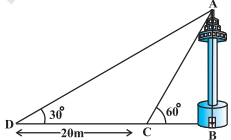
A TV tower stands vertically on a bank of a canal. From a point on the other bank directly opposite the tower, the angle of elevation of the top of the tower is 60°. From another point 20 m away from this point on the line joing this point to the foot of the tower, the angle of elevation of the top of the tower is 30°. Find the height of the tower and the width of the canal.

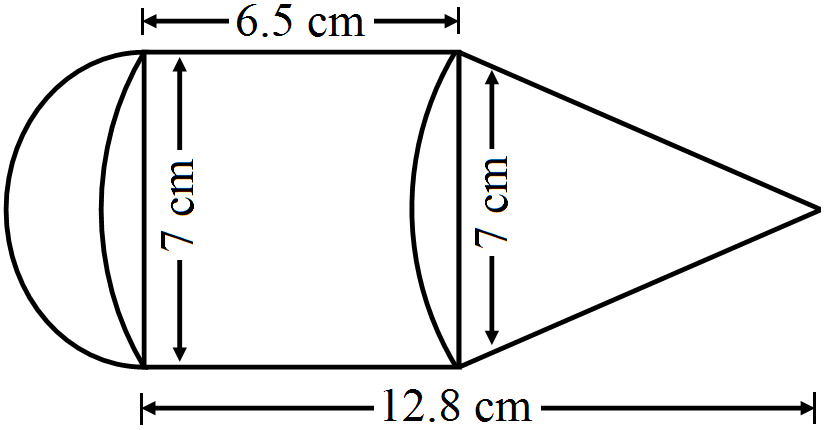
The given figure represents a solid consisting of a cylinder surmounted by a cone at one end and a hemisphere at the other. Find the volurne of the solid.
The sum of the $5^{\text {th }}$ and the $7^{\text {th }}$ terms of an $A P$ is 52 and the $10^{\text {th }}$ term is 46 . Find the AP.
Obtain the condition for the following system of linear equations to have a unique solution:
$ax + by = c$
$lx + my = n$
Prove the identity: $\frac{1}{\operatorname{cosec} \theta+\cot \theta}-\frac{1}{\sin \theta}=\frac{1}{\sin \theta}-\frac{1}{\operatorname{cosec} \theta-\cot \theta}$