Question
Solve the following quadratic equations by factorization:
$\frac{\text{x}-\text{a}}{\text{x}-\text{b}}+\frac{\text{x}-\text{b}}{\text{x}-\text{a}}=\frac{\text{a}}{\text{b}}+\frac{\text{b}}{\text{a}}$
Answer

$\frac{\text{x}-\text{a}}{\text{x}-\text{b}}+\frac{\text{x}-\text{b}}{\text{x}-\text{a}}=\frac{\text{a}}{\text{b}}+\frac{\text{b}}{\text{a}}$
$\Rightarrow\frac{\text{x}-\text{a}}{\text{x}-\text{b}}-\frac{\text{a}}{\text{b}}=\frac{\text{b}}{\text{a}}-\frac{\text{x}-\text{b}}{\text{x}-\text{a}}$
$\Rightarrow\frac{\text{bx}-\text{ab}-\text{ax}+\text{ab}}{\text{b}(\text{x}-\text{b})}=\frac{\text{bx}-\text{ab}-\text{ax}+\text{ab}}{\text{a}(\text{x}-\text{a})}$
$\Rightarrow\frac{\text{bx}-\text{ax}}{\text{b}(\text{x}-\text{b})}=\frac{\text{bx}-\text{ax}}{\text{a}(\text{x}-\text{a})}$
$\Rightarrow\frac{\text{bx}-\text{ax}}{\text{b}(\text{x}-\text{b})}-\frac{\text{bx}-\text{ax}}{\text{a}(\text{x}-\text{a})}=0$
$\Rightarrow(\text{bx}-\text{ax})\bigg(\frac{1}{\text{b}(\text{x}-\text{b})}-\frac{1}{\text{a}(\text{x}-\text{a})}\bigg)=0$
$\Rightarrow(\text{b}\text{x}-\text{ax})\bigg(\frac{\text{a}(\text{x}-\text{a})-\text{b}(\text{x}-\text{b})}{\text{a}\text{b}(\text{x}-\text{a})(\text{x}-\text{b})}\bigg)=0$
$\Rightarrow\frac{\text{x}(\text{b}-\text{a})(\text{ax}-\text{bx}-\text{a}^2+\text{b}^2)}{\text{ab}(\text{x}-\text{a})(\text{x}-\text{b})}=0$
$\because\text{x}\neq\text{a},\text{x}\neq\text{b}$
(Division by Zero is not possible)
$\therefore\text{x}(\text{ax}-\text{bx}-\text{a}^2+\text{b}^2)=0$
Either $\text{x}=0$
or $\text{ax}-\text{bx}=\text{a}^2-\text{b}^2$
$\Rightarrow(\text{a}-\text{b})\text{x}=(\text{a}+\text{b})(\text{a}-\text{b})$
$\Rightarrow\text{x}=\frac{(\text{a}+\text{b})(\text{a}-\text{b})}{\text{a}-\text{b}}=\text{a}+\text{b}$
Hence, $\text{x}=0,\text{a}+\text{b}$

Need a full question paper?

Generate a complete, print-ready paper with questions like this in minutes — across 16+ boards, with answer keys.

Start Generating Free

Similar questions

A toy is in the shape of a right circular cylinder with a hemisphere on one end and a cone on the other. The radius and height of the cylindrical part are 5cm and 13cm respectively. The radi of the hemispherical and the conical parts are the same as that of the cylindrical part. Find the surface area of the toy, if the total height of the toy is 30cm.
For the following statments state whether true (T) or false(F):
The polygon formed by joining the midpoit of the sides of a quadrilateral is a rhombus.
In the following, one of the six trigonometric ratios is given. Find the values of the other trigonometric ratios.
$\sec\theta=\frac{13}{5}$
Solve the following quadratic equation:
$\Big(\frac{\text{x}}{\text{x}}+1\Big)^2-5\Big(\frac{\text{x}}{\text{x}+1}\Big)+6=0,$ $\text{x}\neq-1$
The product of Tanay's age $($in years$)$ five years ago and his age ten years later is $16.$ Determine Tanay's present age.
A frustum of a right circular cone has a diameter of base 20cm, of top 12cm, and height 3cm. Find the area of its whole surface and volume.
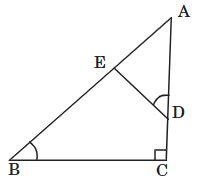
In $\triangle A B C$, If $\angle A D E=\angle B$, then prove that $\triangle A D E \sim \triangle A B C$.
Also if $A D=7.6 cm, A E=7.2 cm, B E=4.2 cm$ and $B C=5.4 cm$, then find $D E$.
Image
Find the coordinates of the point R on the line segment joining the points P(-1, 3) and Q(2, 5) such that $\text{PR}=\frac{3}{5}\text{PQ}.$
A straight highway leads to the foot of a tower. A man standing on the top of the tower observes a car at an angle of depression of 30°, which is approaching the foot of the tower with a uniform speed. Six secounds later, the angle of depression of the car is fo d to be 60°. Find the time taken by the car to reach the foot of the tower form this point.
Solve the following quadratic equations by factorization:
$\frac{\text{x}+1}{\text{x}-1}-\frac{\text{x}-1}{\text{x}+1}=\frac{5}{6},$ $\text{x}\neq1,-1$